by WebPost | Dec 17, 2014 | Adult Spiritual Education
Humans in the Natural World will be the subject of a presentation by Dr. Harry Wistrand, Professor of Biology, Emeritus, Agnes Scott College on January 11 at 9:30-10:45. The talk/discussion is part of the environmental series being sponsored by Adult Spiritual Education and Peace and Social Concerns. Dr. Wistrand will .address questions such as Where did we come from? Why do we possess certain traits? Where do we fit in the universe and this planet? These questions, and many others, have been posed by countless philosophers, theologians, cosmologists, biologists, and others for thousands of years.
Religious doctrine has often suppressed open scientific inquiry into these questions. Charles Darwin delayed publication for over a decade of his pivotal book, On the Origin of Species, because he was fearful of the religious controversy it would generate. Are humans a special creation or a very special species evolving like all other species on this planet? Dr. Wistrand will try to summarize human evolution as it is understood today, the traits which distinguish us, and the traits we have in common with our closest relatives. He hopes most of the session will consist of questions and discussion.
by WebPost | Dec 17, 2014 | Adult Spiritual Education
Jean Jones Andersen’s passion for spiritual education led her to leave our community funds to support adults in taking classes, retreats, workshops, etc. to further their spiritual education. If you have an idea, vision, or leading towards some kind of spiritual growth opportunity—spiritual formation retreat, classes, etc.–and you need funds to make it happen, the members of the Adult Spiritual Education Committee–clerk Mary Fran Hughes-McIntyre, Bette Gilchrist, Betsy Brinson, Monica Shaw, and Leslie Shiel–invite you to submit your request–a letter to our committee–explaining the project and asking for what you need.
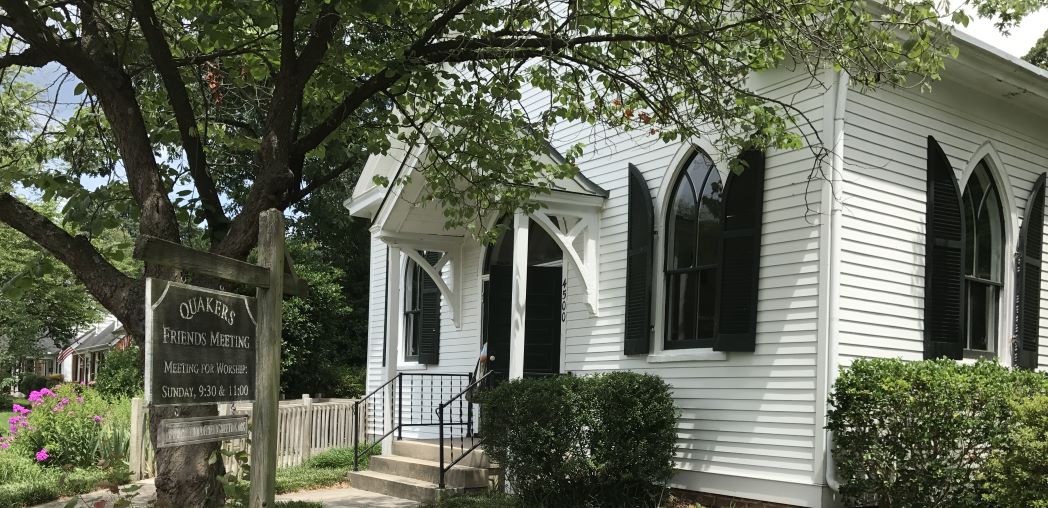
You may leave your letter in the ASE mailbox at meeting house, mail it to Richmond Friends Meeting, 4500 Kensington Avenue, VA 23221-2301 (c/o Adult Spiritual Education Committee), or email one of the committee members.
by WebPost | Dec 17, 2014 | Adult Spiritual Education
The committees of Ministry and Worship and Adult Spiritual Education invite you to….
….Save the date! Saturday, February 28th 2015……for a Winter Retreat day at The Clearing!
Lynn Domina, poet and teacher, will lead us in a day of finding spiritual and creative expression through writing, surrounded and inspired by the lovely quietude of the Clearing in winter. Regardless of previous writing experience or aspirations, this will be a day all can enjoy.
Divine Words: Writing Your Spirituality
Those flashes of transcendence—many of us have experienced one or two. Those dark nights of the soul—most of us have also survived those. Those ordinary moments that fill our days—we move through them, remembering and forgetting and remembering. We describe our experience to others and try to make sense of it for ourselves.
During this retreat we’ll explore how writing can help us discover, express, and deepen our spirituality. The day will be structured so that participants have ample time to write as well as to share. We’ll also look at excerpts from the work of writers often thought of as spiritual—and maybe some we’d never thought to call spiritual. The facilitator will provide many prompts and examples, and the day will be designed so that everyone can benefit.
Lynn is the author of several books, including two collections of poetry, “Corporal Works” and “Framed in Silence”, and the editor of a collection of essays, “Poets on the Psalms”. She teaches English at the State University of New York at Delhi, in the western Catskills, and she is also an M.Div. student at the Earlham School of Religion. She lives with her family in a 200-year old home with lots of plumbing problems.
by WebPost | Sep 22, 2014 | Adult Spiritual Education
Several men in our Meeting have expressed an interest in having another Men’s Retreat at The Clearing this fall. The retreats are held under the broad oversight of Ministry and Worship. A small committee plans and facilitates the retreat.
This is an invitation to all men in the meeting to come to a retreat this fall, from about 8:30 am to 4:00 pm on a Saturday. Please let Jim Thoroman know if you are interested in coming. Also, let him know if you would like to join three or four others for lunch to plan the days activities. (Dan Shaw has already agreed to help with planning and Juan Whittington is always involved.)
Please respond with best October, November, or early December Saturday dates by Saturday, Sept 27 so we can choose a date. With the new heating system at the Lodge, we can meet comfortably even if the weather is cold!
Send email replies to Jim . He and Dan Shaw can answer any questions you might have.
For more information about The Clearing, see The Clearing page on RFMs website at https://testsite.richmondfriends.org/
Past retreats have been enjoyable and satisfying. Hope to see you there!
by WebPost | Sep 22, 2014 | Adult Spiritual Education
Jean Jones Andersen was a lifelong student of the Bible, world religions and spirituality. In her later years, she initiated and facilitated many spirit-led groups in her home which she called “Questers Lodge”, including dream work, Jungian studies, Islamic studies, and the multi-year Education for Ministry. She also started Bible Workbench, for years a weekly gathering at 9:30 at our Meeting.
Jean always challenged us in our spiritual journeys, but above all she led by example. She invited others into her home, her life, and into the process of her dying. Many of us grew intellectually and spiritually thanks to her programs. Many were deeply touched by her and by her encouraging us to “trust the process.”
When she passed away in 2009, she left Richmond Friends Meeting a generous bequest that she intended to be a challenge regarding the future of adult spiritual education in our Meeting. Her bequest became our Adult Spiritual Education Fund, which has since helped us expand our library, engage workshop leaders, continue Bible Workbench, give scholarships to Quaker conferences and sponsor longer term programs, like “The New Jim Crow” series. As a result RFM committees have been inspired to work together and invigorate adult spiritual education in our Meeting.
The Adult Spiritual Education Committee now plans to collect memories of Jean, which we will compile and preserve in our policy and procedures manual. This will assure that as the years pass, Friends will continue to know and appreciate the many ways that Jean inspired our community.
We invite you to remember Jean, write something about your experiences with her, and send written memories to Monica Shaw of the Adult Spiritual Education committee.
by WebPost | Jul 29, 2014 | Adult Spiritual Education, Peace and Social Concerns
WHITE PRIVILEGE: UNPACKING THE INVISIBLE KNAPSACK by PEGGY McINTOSH
(Introduced by Marilyn Gilmore) (Edited by Pat Schenck)
Peggy McIntosh, a White feminist scholar, identified a long list of societal privileges that she received simply because she was White. She did not ask for them, and it is important to note that she hadn’t always noticed that she was receiving them. They included major and minor advantages.
It’s one thing to have enough awareness of racism to describe the ways that people of color are disadvantaged by it. But a new understanding of racism is more elusive. In very concrete terms, it means that if a person of color is the victim of housing discrimination, the apartment that would otherwise have been rented to that person of color is still available for a White person. The White tenant is, knowingly or unknowingly, the beneficiary of racism, a system of advantage based on race. The unsuspecting tenant is not to blame for the prior discrimination, but she benefits from it anyway.
For many Whites, this new awareness of the benefits of a racist system elicits considerable pain, often accompanied by feelings of anger and guilt. These uncomfortable emotions can hinder further discussion of race and racism. We all like to think that we deserve the good things we have received, and that others, too, get what they deserve. Social psychologists call this tendency a “belief in a just world.” Racism directly contradicts such notions of justice.
Understanding racism as a system of advantage based on race is contrary to traditional notions of an American meritocracy. For those who have internalized this myth, this definition generates considerable discomfort. It is more comfortable simply to think of racism as a particular form of prejudice. Notions of power or privilege do not have to be addressed when our understanding of racism is constructed that way.
It is important to understand that the system of advantage is perpetuated when we do not acknowledge its existence. And now, on to Peggy’s paper.
Through work to bring materials and perspectives from Women’s Studies into the rest of the curriculum, I have often noticed men’s unwillingness to grant that they are over-privileged in the curriculum, even though they may grant that women are disadvantaged. Denials which amount to taboos surround the subject of advantages which men gain from women’s disadvantages. These denials protect male privilege from being fully recognized, acknowledged, lessened, or ended. Thinking through unacknowledged male privilege as a phenomenon with a life of its own, I realized that since hierarchies in our society are interlocking, there was most likely a phenomenon of white privilege which was similarly denied and protected, but alive and real in its effects. As a
white person, I realized I had been taught about racism as something which puts others at a disadvantage, but had been taught not to see one of its corollary aspects, white privilege, which puts me at an advantage.
I think whites are carefully taught not to recognize white privilege, as males are taught not to recognize male privilege. So I have begun in an untutored way to ask what it is like to have white privilege. This paper is a partial record of my personal observations, and not a scholarly analysis. It is based on my daily experiences within my particular circumstances.
I have come to see white privilege as an invisible package of unearned assets which I can count on cashing in each day, but about which I was “meant” to remain oblivious. White privilege is like an invisible, weightless knapsack of special provisions, assurances, tools, maps, codes, code books, passports, visas, clothes, compasses, emergency gear, and blank checks.
My schooling gave me no training in seeing myself as an oppressor, as an unfairly advantaged person, or as a participant in a damaged culture. I was taught to see myself as an individual whose moral state depended on her individual moral will. At school, we were not taught about slavery in any depth; we were not taught to see slaveholders as damaged people. Slaves were seen as the only group at risk of being dehumanized. My schooling followed the pattern which Elizabeth Minnich pointed out: whites are taught to think of their lives as morally neutral, normative, average, and also ideal, so that when we work to benefit others, this is seen as work which will allow “them” to be more like “us.”
After frustration with men who would not recognize male privilege, I decided to try to work on myself at least by identifying some of the daily effects of white privilege in my life. It is crude work, at this stage, but I will give here a list of special circumstances and conditions I experience which I did not earn but which I have been made to feel are mine by birth, by citizenship, and by virtue of being a conscientious law-abiding “normal” person of good will. I have chosen those conditions which I think in my case attach somewhat more to skin-color privilege than to class, religion, ethnic status, or geographical location, though of course all these other factors are intricately intertwined. As far as I can see, my African-American co-workers, friends, and acquaintances with whom I come into daily or frequent contact at this particular time, place and line of work cannot count on most of these conditions.
- I can, if I wish, arrange to be in the company of people of my own race most of the time.
- I can avoid spending time with people whom I was trained to mistrust and who have learned to mistrust my kind, or me.
- If I should need to move, I can be pretty sure of renting or purchasing housing in an area which I can afford and in which I would want to live.
- I can be pretty sure that my neighbors in such a location will be neutral or pleasant to me.
- I can go shopping alone most of the time, pretty well assured that I will not be followed or harassed.
- I can turn on the television or open to the front page of the paper and see people of my race widely represented.
- When I am told about our national heritage or about “civilization,” I am shown that people of my color made it what it is.
- I can be sure that my children will be given curricular materials that testify to the existence of their race.
- If I want to, I can be pretty sure of finding a publisher for this piece on white privilege.
- I can be pretty sure of having my voice heard in a group in which I am the only member of my race.
- I can be casual about whether or not to listen to another woman’s voice in a group in which she is the only member of her race.
- I can go into a music shop and count on finding the music of my race represented, into a supermarket and find the staple foods which fit with my cultural traditions, into a hairdresser’s shop and find someone who can cut my hair.
- Whether I use checks, credit cards, or cash, I can count on my skin color not to work against the appearance of financial reliability.
- I can arrange to protect my children most the time from people who might not like them.
- I do not have to educate my children to be aware of systemic racism for their own daily physical protection.
- I can be pretty sure that my children’s teachers and employers will tolerate them if they fit school and workplace norms; my chief worries about them do not concern others’ attitudes toward their race.
- I can talk with my mouth full and not have people put this down to my color.
- I can swear, or dress in second-hand clothes, or not answer letters, without having people attribute these choices to the bad morals, the poverty, or the illiteracy of my race.
- I can speak in public to a powerful male group without putting my race on trial.
- I can do well in a challenging situation without being called a credit to my race.
- I am never asked to speak for all the people of my racial group.
- I can remain oblivious of the language and customs of persons of color who constitute the world’s majority without feeling in my culture any penalty for such oblivion.
- I can criticize our government and talk about how much I fear its policies and behavior without being seen as a cultural outsider.
- I can be pretty sure that if I ask to talk to “the person in charge,” I will be facing a person of my race.
- If a traffic cop pulls me over or if the IRS audits my tax return, I can be sure that I haven’t been singled out because of my race.
- I can easily buy posters, post-cards, picture books, greeting cards, dolls, toys, and children’s magazines featuring people of my race.
- I can go home from most meetings of organizations I belong to feeling somewhat tied in, rather than isolated, out-of-place, outnumbered, unheard, held at a distance, or feared.
- I can be pretty sure that an argument with a colleague of another race is more likely to jeopardize her chances for advancement than to jeopardize mine.
- I can be pretty sure that if I argue for the promotion of a person of another race, or a program centering on race, this is not likely to cost me heavily within my present setting, even if my colleagues disagree with me.
- If I declare there is a racial issue at hand, or there isn’t a racial issue at hand, my race will lend me more credibility for either position than a person of color will have.
- I can choose to ignore developments in minority writing and minority activist programs, or disparage them, or learn from them, but in any case, I can find ways to be more or less protected from negative consequences of any of these choices.
- My culture gives me little fear about ignoring the perspectives and powers of people of other races.
- I am not made acutely aware that my shape, bearing, or body odor will be taken as a reflection on my race.
- I can worry about racism without being seen as self-interested or self-seeking.
- I can take a job with an affirmative action employer without having my co-workers on the job suspect that I got it because of my race.
- If my day, week, or year is going badly, I need not ask of each negative episode or situation whether it has racial overtones.
- I can be pretty sure of finding people who would be willing to talk with me and advise me about my next steps, professionally.
- I can think over many options, social, political, imaginative, or professional, without asking whether a person of my race would be accepted or allowed to do what I want to do.
- I can be late to a meeting without having the lateness reflect on my race.
- I can choose public accommodation without fearing that people of my race cannot get in or will be mistreated in the places I have chosen.
- I can be sure that if I need legal or medical help, my race will not work against me.
- I can arrange my activities so that I will never have to experience feelings of rejection owing to my race.
- If I have low credibility as a leader, I can be sure that my race is not the problem.
- I can easily find academic courses and institutions which give attention only to people of my race.
- I can expect figurative language and imagery in all of the arts to testify to experiences of my race.
- I can choose blemish cover or bandages in “flesh” color and have them more or less match my skin.
I repeatedly forgot each of the realizations on this list until I wrote it down. For me, white privilege has turned out to be an elusive and fugitive subject. The pressure to avoid it is great, for in facing it I must give up the myth of meritocracy. If these things are true, this is not such a free country; one’s life is not what one makes it; many doors open for certain people through no virtues of their own. These perceptions mean also that my moral condition is not what I had been led to believe. The appearance of being a good citizen rather than a troublemaker comes in large part from having all sorts of doors open automatically because of my color.
In this potpourri of examples, some privileges make me feel at home in the world. Others allow me to escape penalties or dangers which others suffer. Through some, I escape fear, anxiety, or a sense of not being welcome or not being real. Some keep me from having to hide, to be in disguise, to feel sick or crazy, to negotiate each transaction from the position of being an outsider, or, within my group, a person who is suspected of having too close links with a dominant culture. Most keep me from having to be angry.
I see a pattern running through the matrix of white privilege, a pattern of assumptions which were passed on to me as a white person. There was one main piece of cultural turn; it was my own turf, and I was among those who could control the turf. I could measure up to the cultural standards and take advantage of the many options I saw around me to make what the culture would call a success
of my life. My skin color was an asset for any move I was educated to want to make. I could think of myself as “belonging” in major ways, and of making social systems work for me. I could freely disparage, fear, neglect, or be oblivious to anything outside of the dominant cultural forms. Being of the main culture, I could also criticize it fairly freely. My life was reflected back to me frequently enough so that I felt, with regard to my race, if not my sex, like one of the real people.
Whether through the curriculum or in the newspaper, the television, the economic system, or the general look of people in the streets, we receive daily signals and indications that my people counted, and that others either didn’t exist or must be trying, not very successfully, to be like people of my race. We were given cultural permission not to hear voices of people of other races, or a tepid cultural tolerance if we did happen to hear them.
In proportion, as my racial group was being made confident, comfortable, and oblivious, other groups were likely being made to lack confidence, comfort, and to feel alienated. Whiteness protected me from many kinds of hostility, distress and violence, which I was being subtly trained to visit in turn upon people of color.
It seems to me that obliviousness about white advantage is kept strongly enculturated in the United States so as to maintain the myth of meritocracy, the myth that democratic choice is equally available to all. Keeping most people unaware that freedom of confident action is there for just a small number of people props up those in power, and serves to keep power in the hands of the same groups that have most of it already.
Though systematic change takes many decades, there are pressing questions for me and I imagine for some others like me if we raise our daily consciousness on the dividends of being light-skinned. What will we do with such knowledge? …(I)t is an open question whether we will choose to use unearned advantage to weaken hidden systems of advantage, and whether we will use any of our arbitrarily-awarded power to try to reconstruct power systems on a broader base.