
RFM Religious Education Building Renovation Kickoff Dinner


By Donna Knicely, member of the History Committee
If you have lived in Richmond very long at all, you have probably heard of the Friends Association for Children. And, as a Quaker, you have probably wondered what the connection is between the two. The following history was provided by staff of the Friends Association for Children.
Friends Association, currently located at 1004 Saint John Street, was founded shortly after the Civil War. A group of black civic workers, the Ladies Sewing Circle for Charitable Works, recognized the need for an orphanage for black children who were left homeless following the War. Turmoil surrounding the abolition of slavery left many children in the Richmond area without parents, relatives or guardians.
Mrs. Lucy Goode Brooks, the Sewing Circle leader, convinced the members of her group that support was needed from community groups to undertake the project. She sought the endorsement and financial aid for the orphanage from the Richmond Society of Friends. It is believed that Society was approached because some members of the Sewing Circle had lived with Quaker families before and during the War and recognized their humanitarian interest in the less fortunate and oppressed. The group was also aware of the financial contributions Quakers had made to the education of black children in other communities.
Under the direction of John Baker Crenshaw, the Quakers became active in the effort to find relief for black orphans in Richmond. Mr. Crenshew was the minister of the Richmond Society of Friends and grandfather of former Judge J. Hodge Ricks of the Juvenile and Domestic Court. The Quakers agreed to sponsor the orphanage project and raised money in Virginia and in the Northern States. On August 12, 1867, the Richmond City Council voted to deed the “Old Orphan Asylum” lot at the corner of Saint Paul and Charity Streets to the Trustees of the Society of Friends for the construction of an orphanage for black children. The building was completed in 1871, and the Friends Asylum for Colored Orphans was incorporated by the Virginia General Assembly on March 26, 1872.
The organization was governed by white trustees until 1889. At that time, the composition of the Board of Trustees was altered to include only representatives of black, Richmond area Baptist churches. The number of trustees was determined by the financial support provided by each church. In recognition of this change, the Richmond City Council deeded the property to the Friends Asylum for Colored Orphans. Increased funding was granted to the Asylum in 1926 following a study by the Community Fund and the Child Welfare League of America, which concluded that the orphanage was vital to the city. After another study in 1929 it was determined that foster home care was more needed than an orphanage. In 1931 the orphanage was closed and the group became a foster care agency under the supervision of the Children’s Aid Society of Richmond.
In 1932 after separating from the Children’s Aid Society, the group was renamed the Friends Association for Colored Children. About this time services began to change in order to respond to the needs of the community. An adoption service was started in 1938 and a program providing counseling services to children in their homes was initiated in 1940. In 1947 Friends Association began the evolution of its current Child Care Program by opening the Community Day Nursery. In 1955 the foster care program was replaced by a pre-adoption boarding home and services for the unwed mother.
Today the Friends Association for Children is guided by three basic tenets: “child care is our business, the family is important to us, and we make it possible for children to reach their potential.”
1795 — “At a Monthly Meeting held at White Oak Swamp. 2nd day, 7th month, 1795. The members of Swamp Meeting were joined to Richmond Meeting which is to be held on First and Fourth days of the week, and to begin on the First Day the 15th of this month.” (Valentine Museum typescript, 1795) [See VA Historical Marker]
1796 — Minutes mention Friends in Richmond meeting in “the present room.” (Valentine typescript, 10th of 1 month, 1796)
— “At a Monthly Meeting held at White Oak Swamp 4th of the 6th mo. 1796. The Friends of Richmond through the channel of the Preparative Meeting requests the approbation of this Meeting to build a Meeting House there.” (Valentine type script, p. 254)
1797 — “11-4-1797 — The Committee appointed by last Meeting to consult with Friends of Richmond in respect to getting a more suitable lot there for the purpose of building a Meeting House, reported that they had attended to the service and fixed on one the lower side of Shockoe Creek which is procured for that purpose instead of the other one proposed; and the size of the house extended to forty feet square, which is in considerable forwardness, the completion whereof is left to the Committee appointed for that purpose.” (White Oak Swamp Monthly Meeting minute, summarized from Valentine typescript)
1798 — “At a Monthly Meeting at White Oak Swamp on 5th day of the 5th month 1798: Queries to Meeting — One new Meeting House built in Richmond.” (Summary of Valentine typescript, p. 281)

Mary Winston’s needlework thought to be in the first Friends Meeting House built by George Winston. It was embroidered by Mary Winston in 1806. The buildings near the bottom are two views of the Richmond Friends Meeting house located at 19th and Cary Street.
Contributed by Donna Rugg

Portrait of Hannah Watts Clarke, circa 1840, with first Richmond Friends Meetinghouse visible through window.
1810 — The location of the meetinghouse is shown on the northeast corner of Cary and 19th Streets. (“Richmond Virginia in Old Prints,” Johnson Publishing Co., 1932,) p. 32.)
1819 — The Samuel Parsons House at 601 Spring Street was built from 1817 to 1819. The Parsons were members of the Richmond Meeting which met at 19th and East Cary Streets. Samuel Parsons was superintendent of the nearby Penitentiary during the 1820’s. The building later became Spring Street Home for Unwed Mothers, then harbored pensioners, then the Welfare Department. (M.W. Scott, p. 212)
1836 — “In 1836, the meeting house was so badly damaged by fire that it was necessary to appoint a committee to consider the matter of rebuilding…. It would seem from the records that $250 was received toward the rebuilding of the new meeting house. We suppose this amount was in addition to what was raised from the sale of the church property. At any rate, a new meeting house of frame, surrounded by a high brick wall, was built at the corner of 19th and Cary Streets, date not given.” (“Richmond Friends” by Matthew F. Woodard, 1929)
1853 — Description of the first meetinghouse: “Their earliest meetinghouse was of brick, with a graveyard just north of it….In 1853 a writer in the Dispatch described the rude building with its unpainted interior set in a graveyard without stones but covered with eglantine — an oasis in the desert of factories and warehouses.” (Scott, p. 67, citing the Richmond Times Dispatch June 15th, 1853.)
1862 — During the War between the States, the meetinghouse was forcibly occupied by Confederate troops. It was located between Castle Thunder (prison for Southerners) and Castle Libby (prison for Federal soldiers). It may have been used as a hospital, according to oral tradition. (Letter from Cedar Creek Monthly Meeting, 1st mo., 27th 1875, quoted below)
— The deed for the lot on 19th and Cary St. was sold, except the graveyard, in 1862. Three lots in Hollywood Cemetery numbered 121, 122, and 123 in Section L were purchased for $173 n 1863. (Cedar Creek Monthly Meeting Minutes, 1862, p. 218. Richmond Monthly Meeting Minutes, 9th month, 12th, 1894 p. 17)
1867 — “One building of a public character that survives is Springfield Hall…which was erected at 16th and M around 1850. Just after the Civil War the Society of Friends used this as its meetinghouse.” (Scott, p. 24. Picture is on p. 22.)
 Springfield Hall, 26th and M (700 26th Street), 1867-1868
l868 — Location of the meetinghouse built after the Civil War was on the south side of Clay Street, west of First. In 1955 it was still standing and used as the Moses Memorial Baptist Church. (Richmond Times-Dispatch July 17th 1955) Pictures of this meetinghouse’s interior are to be placed in the Quaker Collection, Haverford College.)
 9 East Clay Street, 1868-1909
1871 — Management of Friends Orphan House for Colored Children built by Friends (East corner of St. Paul Street and West Charity Street) after the Civil ended was officially offered to the colored churches of Richmond and Manchester. [See VA Historical Marker.]
1875 — “Cedar Creek Monthly Meeting of Friends, Richmond, Va. 1st Month, 25th, 1875 [See VA Historical Marker]. Dear Friends: Friends of the above Monthly Meeting earnestly solicit thy favorable consideration and pecuniary assistance in liquidating the liability incurred by the building of their new meeting-house. During the war the old meeting-house, situated betwixt Castle Thunder and Castle Libby, was forcibly taken possession of by the Confederate soldiery, and friends, after suffering much annoyance, found shelter for a while in a private house, and afterwards in a rented room. Before the close of the war the old meeting-house was sold for Confederate money, and the proceeds invested in railroad bonds, from which loss was sustained.. . .“ (Letter signed on behalf of Cedar Creek Monthly Meeting by John B. Crenshaw, et al)
1909 — The property on Clay street was sold, and meetings were held, for the most part, in the YMCA Building, second floor. (Woodard, p. 1)
1929 — Friends purchased a building “constructed of plain white stucco. It is quite attractive, because of its simplicity and beauty. The location is good being opposite a small park and in the midst of a very good residential section.” (Woodard, p. 1) This meetinghouse was located at the north east corner of Park and Meadow. (Ulrich Troubetzkoy, “The Society of Friends in Richmond,” Richmond Times Dispatch, 1955)
 1804 Park Avenue, 1929-1945
1943 — Friends met at Grace Covenant Presbyterian Church during the winter due to war—time fuel shortages. (Richmond Monthly Meeting Minutes, February 15, 1953)
1945 Sale of the Meetinghouse at 1804 Park Avenue at the north east corner of Park Avenue and Meadow Street, to Calvary Pentecostal Tabernacle of the Assemblies of God for $16,750 cash. Friends felt it inadvisable to buy another meeting house on the current market. (Richmond Monthly Meeting Minutes, 5-13-45, pp. 205, 208)
— Friends met In an annex on the east side of Tabernacle Baptist Church ‘ 115 Grove Avenue, or In the YMCA from l9 through 1953. (Richmond Monthly Meeting Minutes, February 15, 1953)
1953 — Friends met at 2702 Grove Avenue in a converted residence. (Richmond Monthly Meeting Minutes, December 7, 1952) This was sold because it did not meet fire regulations. (Jessie Frazer Hartley interview, April 8, 1979)
 2702 Grove Avenue, 1953-1957
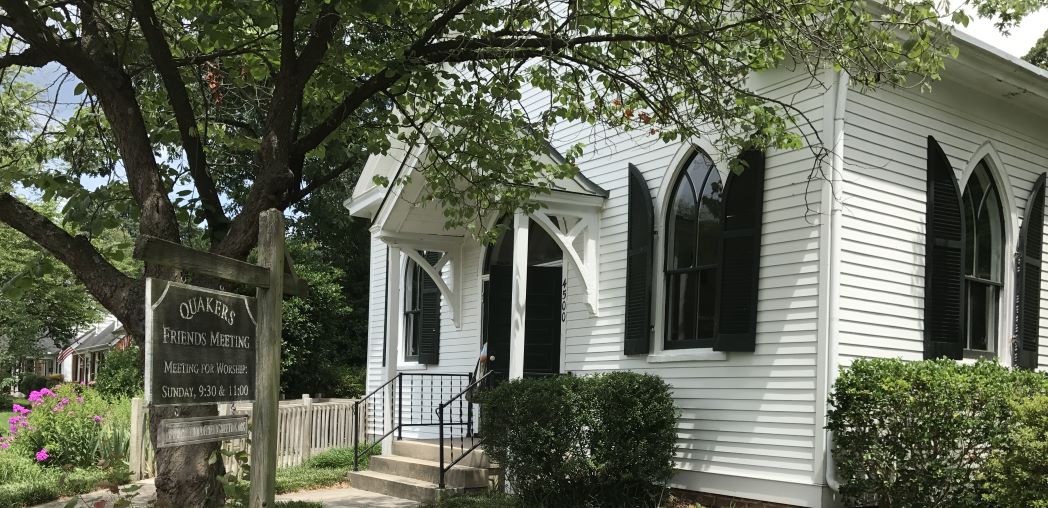
1957 — The current meetinghouse at 4500 Kensington Avenue was purchased from Colonial Place Christian Church. “The Meeting approves the minute that the Trustees of the Meeting be authorized to negotiate a real estate transaction for the sale of 2702 Grove Avenue at $16,500 and the subsequent purchase of 4500 Kensington Avenue at $l7,500, or otherwise, the transaction to be at any differential of $1000.” (Richmond Monthly Meeting Minutes, February 14, 1957)
 4500 Kensington Avenue, 1957-present

4500 Kensington Avenue Deed of Sale, 1957
[Narrative above from: Hughes, Mary Fran (1979). The History of Richmond Friends Meeting 1795-1962 (Appendix – Location of Richmond Friends Meetinghouses). Unpublished. Link to full document: THE HISTORY OF RICHMOND FRIENDS MEETING 1795-1962 ]
1963 There is no mention of specific membership numbers in the minutes but it appears the Meeting had very few members during the 1960s. ( An influx was seen in the 1970s.)
Robert Clark, Clerk
Most of the Meeting for Business Notes are penciled notes for the 1960s.
January:
February:
March:
June:
August:
September:
1964
August
1965 and 1966 Jay Worrall, Clerk
Feb 12, 1965:
January, 1966:
Feb 2, 1966
Feb 27, 1966
March, 1966
April 1966
May, 1966
July, 1966
1967
Robert Clark, Clerk
April, 1967
May, 1967
September 1967
November, 1967
1968
Rowland Leonard, Clerk
May 1968
September, 1968
October, 1968
November, 1968
December, 1968
January 1969
Clerk, Jessie F. Hartley
NO RECORDS INCLUDED FROM 1969-1974.
Prepared by Betsy Brinson, Ph.D.
RFM Historian
May, 2003
One of the most divisive events in 20th century U.S. history was the war in Vietnam. The antiwar movement gained national prominence in 1965, peaked in 1968, and remained powerful throughout the duration of the conflict. In June 1967, in keeping with our position against war, the Richmond Friends Meeting hosted in our Kensington Avenue building the office for the Vietnam Summer Project, a statewide program opposing U.S. involvement in Vietnam.
In June 1967, in keeping with our position against war, the Richmond Friends Meeting hosted in our Kensington Avenue building the office for the Vietnam Summer Project, a statewide program opposing U.S. involvement in Vietnam. Phyllis Conklin and Marii Hasegawa, representing the Women’s International League for Peace and Freedom, led the statewide Vietnam Summer Project. (The Richmond WILPF chapter, newly organized by Phyllis and Marie, had about ten active members.) Some Richmond Friends Meeting members were also active in the Vietnam Summer Project along with other community individuals, who opposed the war.
Ben Ragsdale, a young student, was hired to help coordinate the program, which had groups in Norfolk, Hampton, Northern Virginia, Charlottesville, Lexington, Roanoke and Farmville. Ben recalls doing a lot of moving around the state. He indicates that the college campuses were not as active as they were later because it was the summer and students were not in attendance. He also recalls receiving a small paycheck every two weeks.
The Vietnam Summer Project attempted to host a peaceful antiwar rally at the Richmond War Memorial but was denied a permit. The ACLU filed an injunction against the ruling, which found them before the newly installed Judge Mehrige in federal court. Judge Mehrige told them that it was a constitutional issue and refused an injunction until the case could be heard in federal court. When Phyllis and Marii protested that this was a one summer’s protest project and the convocation was to be the end of it, Judge Mehrige told them that he was certain there were enough concerned people to keep the group alive until the case could receive a proper hearing. Bob Conklin recalls that while the Judge was in favor of granting the permit, he delayed the opinion in part because of his newness on the bench and the public controversy over the war itself. The 1967 peace rally was held instead at Union Seminary. The court eventually ruled in favor of the Vietnam Summer Project and the peace rally at the War Memorial finally happened a year later with several hundred in attendance.
Minutes of the Richmond Friends Meeting show that the City of Richmond intervened in the Vietnam Summer Project by sending a letter to Meeting, arguing that we did not have a permit for allowing our building to be used for such a purpose. Since the Meeting had for years allowed numerous groups supporting a wide variety of social issues to use RFM for meetings and office space, we can conjecture that this time the city objected because the war was so divisive in the public mind. The Business Meeting though simply agreed to pay for the permit. Ben Ragsdale and Marii Hasegawa do not recall ever knowing about the permit issue so it may well be that the Meeting quietly went ahead and did their part to help the project without concerning others.
RFM member Peg Spangenthal recalls that her husband Art, who served in Italy in World War II, offered counseling to young men concerned about the draft. She remembers hosting groups at their home, where materials were distributed and young men role-played the offered advice. We believe that Jules Arginteanu from the Meeting also offered draft counseling.
Other project activists spoke to church and college groups and responded to media inquiries about why the war in Vietnam was wrong. Bob Conklin recalls attending a meeting at the Unitarian church, where right-wingers blocked the entrance and the hallways, pushing their cameras to within inches of antiwar activist faces before blinding them with flashes. The right-wingers were anxious to rough it up and antiwar activists expected worse. During the meeting, Bob recalls that the debate centered on who eventually should govern Vietnam. A woman, sensing that Phyllis Conklin would favor the Communists, asked, ” Who is there but the Communists to give it to?” Phyllis’s response was “Why, to the people, of course.” As a result, antiwar activists were not hassled on the way out.
Later the police planted an “informer” in the project. “Ed,” as he was known, was apparently a little too enthusiastic about his new mission. He was very anxious to help with mailings, because he wanted to obtain the WILPF mailing list. Organizers were able to put him off and give him inconsequential jobs. Later that year at a City Hall demonstration, members of the group recognized “Ed”—this time dressed in his police uniform. They had a good laugh as one after another they called out, “Hi, Ed!” Ben Ragsdale recalls another plainclothesman, who appeared at project events. His name was Ricky Duling and he eventually became “Sergeant Santa” at Christmas to area children.
This was also the beginning of the Friday peace vigils at the post office. For four years, Phyllis Conklin and other sturdy souls leafleted in opposition to the Vietnam War. In doing this, they were called many names. Phyllis loved to tell that hostility changed to curiosity and even some interest and support as the national challenges to the war increased. She told about a man who stopped her toward the end of the four years and said that he had been watching them all this time. In the beginning he thought they were crazy, but gradually over the years his attitude had changed and now he really admired their perseverance.
Marii Hasegawa recalls that Richmond Friends Meeting played an important role by providing office space and volunteer support. She also recalls that the key to the side door was often very hard to turn and hopes that we have repaired it.
Thanks to Marii Hasegawa, Bob Conklin, Wendy Northup, Ben Ragsdale, Peg Spangenthal, Ann Lane and others who offered information for the above story. Phyllis Conklin died in 1987. Marii Hasagawa, now age 84, resides in a retirement community in South Hadley, Massachusetts. She continues to be active in social justice issues and sends greetings to all her Richmond friends. Ben Ragsdale is presently the director of the Virginia Civil Rights Video Initiative. Betsy Brinson is responsible for the research and writing of this short article. Readers who have additional information to share about the Vietnam Summer Project are invited to contact her at brinson422@comcast.net

THE HISTORY OF RICHMOND FRIENDS MEETING
1795–1962
by
Mary Fran Hughes
Richmond, Virginia
1979
Since joining Richmond Friends Meeting in 1976, I have wondered about the history of my new spiritual family. A sense of our history might give us an appreciation for who we are and can become. Realizing that hardly any of the present active members had been in the Meeting prior to 1960 left me wondering about the danger of our being cut off from our heritage — no one even seemed to know how long it stretched back. (Photo 2003)
My interest was encouraged by Jay Worrall, official historian for Virginia Friends, who generously opened his card files on Virginia Friends’, history. Patricia Hickin, a historian who has worked with the Virginia State Library, likewise shared her historical resources and her enthusiasm for the project. Eda Martin whose interest in family history led to study of Quaker ancestors in Richmond Friends Meeting brought forth notes, books, watercolor portraits, a pilgrimage to Friends’ graves in Hollywood Cemetery, and a deep concern for historical accuracy. The occasion for the history-writing was James Smylie’s American Religious History course at Union Theological Seminary. His insistence that I learn about the broader contexts of Virginia, Richmond, national, and American religious history added depth and occasional discoveries about the topic itself. These persons and William McIntyre read the following history and offered editorial suggestions.
Discovering a history which went hack all the way to 1795 and which was passed down through a single family for about 150 years was breath-taking. With the Meeting’s current Friends General Conference (more Hicksite) orientation, we have a long heritage of Orthodoxy through the lifetime of the Crenshaw family in the Meeting. Our testimonies on peace and reform of the social order have been faithfully lived out as Friends have met silently to wait upon the Lord. From worship came fresh strength and perspective.
Since no systematic history of Richmond Friends Meeting has been previously written, I feel a responsibility to choose themes and to organize them in a way which grows out of the history itself. The hope is that contemporary and future Richmond Friends may gain insight through what has been lived out before. Yet, the focus is on issues alive today. With the current efforts to revive the draft, I have focused on our pacifist history which responded to each war or rumor of war with a peace-making stand. The Meeting’s recent sponsorship of eleven Cambodian refugees is in harmony with Friends testimony on race relations and the abolition of slavery. As we wrestle with our ministry in the prisons and in opposition to capital punishment, we look to our predecessors who did likewise.
May our history move us to “walk cheerfully over the world, looking for that of God in every person.”
Read full paper (PDF)…. THE HISTORY OF RICHMOND FRIENDS MEETING 1795-1962