by WebPost | Dec 21, 1930 | History - RFM
Where the Money Went
A Brief Look at Richmond Friends’ Spending
In the Early Years of the Last Century
The responsibility of a treasurer is to keep careful track of the money coming into and going out of an organization. But the legacy of a treasurer also can be a rich historical record of the values and behavior of a group of people. What a society values is what it spends its money on. It’s true of nations, states, and cities. It’s also true of groups like the Religious Society of Friends.
In 4th month 1917, for instance, Richmond Friends’ treasurer Edwin A. Russell recorded a payment of $46.80 to Richmond Dairy Company for “Colored Orphanage Milk Jan, Feb & Mar.” In 5th month he paid for April: $16.80 for 120 quarts of milk. A few months earlier, he had paid $25.00 to the YWCA to support its “Colored work” – probably its Phyllis Wheatley branch. He also sent $50.00 to the American Friends Service Committee.
The Friends Meeting budget from October 1917 through July 1918 was $981.70. Of that amount, $408.15 was carried forward to the following budget. Most of the money went to support social causes, especially needy African Americans. Some of it went to rent the Blue Room of the YMCA where the Friends met: $2.50 a week. But substantially more than half the actual expenditures of the Meeting were to charity and in support of humanitarian causes.
There were few contributions from members: only an occasional sum for some specific project or group like the Board of Foreign Missions. The Meeting had invested funds in loans secured by real estate: either mortgages or what we now might call home equity loans. The interest supported the operating expenditures.
1918 brought the end of World War I. Friends almost immediately began to support various refugee projects, recognizing the enormous ruin that had been done to property, economies, and human lives. Treasurer Katherine Ricks carried on Friends’ support of local social programs. But she also paid $75.00 for Syrian relief in 1st month, 1919. In the next several months, Friends contributed money to help German and Austrian children and “Sufferers in Near East.” The Meeting also placed advertisements in the Times-Dispatch seeking contributions to these causes from the general public. Soon the needy of Russia and Armenia were added to the list.
1918 also was the year in which a virulent strain of influenza struck the United States, killing thousands. The Meeting contributed funds for the “Nurses Settlement during epidemic,” probably a temporary headquarters for nurses trying to contain the virus.
In 6th month 1920, the Meeting contributed $25.00 to the American Union Against Militarism. The organization is still around. Today, it is known as the American Civil Liberties Union, or ACLU.
After 1921, the treasurers’ entries become much less neat and much more sketchy. It’s difficult to know what is happening but the Meeting still paid rent to the YMCA. No expenditures are recorded for milk for the Colored Orphanage or to support the Phyllis Wheatley branch of the YWCA. Nor are there expenditures for international relief.
But on October 31, 1929, the Meeting paid $17,002.45 to the Trustees of the Christian Science Church to purchase a building at the corner of Park and Meadow in Richmond. From that point on, expenditures are recorded for coal, wood, electricity, and water.
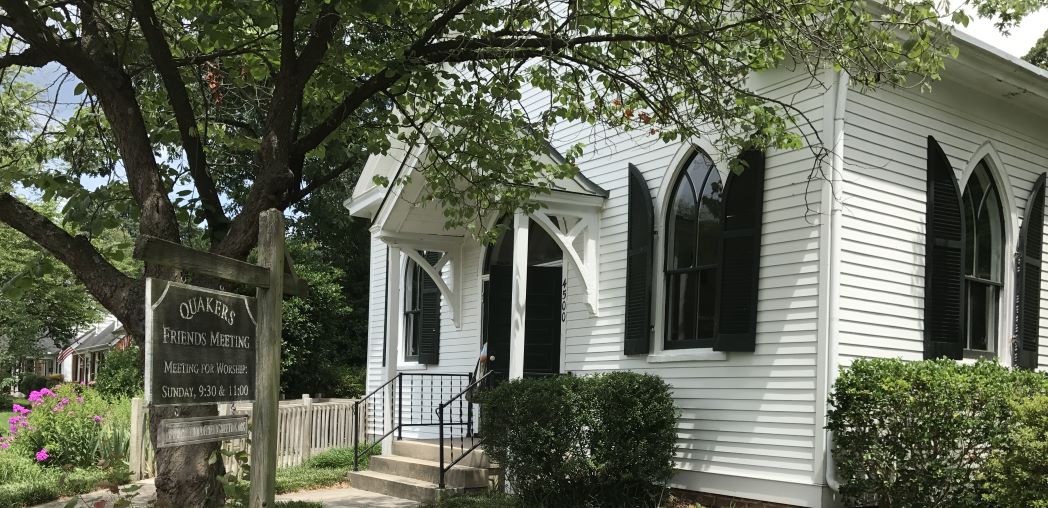
Richmond Friends have had a Meeting House ever since, except for a period during World War II when Friends rented worship space at the YMCA and Covenant Presbyterian Church in order to conserve scarce fuel. It is interesting that the Meeting bought a building in 1929 for $17,000 and then bought another, its present Meeting House, for the an almost identical amount in 1957.
The purchase in 1929 came as the nation slipped into the Great Depression. There is little record in the treasurers’ accounts of the great suffering of that time.
But there is one record. On the 8th day of 5th month, 1930, the treasurer noted simply:
“Money given a stranger – $2.50.”
Contributed by Gordon Davies
* * * *
![Hannah Watts Clarke]()
by WebPost | Dec 19, 1800 | History - Quaker, History - RFM
Hannah Watts Clarke
(circa 1754–1843)
Hannah Watts Clarke was a lifelong member of the Society of Friends. Her portrait, attributed to Charles Burton, an English painter, was done about 1840. She is shown in profile looking out on what is thought to be the first Quaker Meeting House in Richmond, built by George Winston on 19th and Cary Streets.

By 1840 Hannah was a widow and the matriarch of a sizable kinship group of Quakers who had emigrated to Richmond from Northern Ireland in the early 1800’s.
The Clarkes (Hannah, her husband, John, and their eight children) were from County Antrim, Ulster. The transfer of their memberships from Lisburn Monthly Meeting to Richmond Particular Meeting was recorded on the 12th of Third Month, 1801. They left a country plagued by poverty and political unrest following the Union of Ireland and Great Britain in 1800. The family resided on Main Street between 18th and 19th, where John Clarke worked as a grocer nearby. Their home was only a block away from the Meeting House.
The original portrait, which is done in watercolor and pastel, is in the possession of Eda Williams Martin of Williamsburg, Virginia. The photo print here was made from a transparency of the original portrait loaned to us by the Abby Aldrich Rockefeller Folk Art Center in Colonial Williamsburg. There are seventeen extant portraits of Clarke and Sinton family members done by Burton. Hannah’s portrait is the only one showing the Meeting House, perhaps symbolic of the importance of the Meeting in her life as well as realistic. It is the only known depiction of the Meeting House in existence.
Text was supplied by Eda Williams Martin and is based on research she has done in Quaker records.
![Hannah Watts Clarke]()
by WebPost | Dec 19, 1800 | History - Quaker, History - RFM
The Jacob House
by Harry Kollatz, Jr.
The Jacob House is a small place with a big history. During its most recent years, it deteriorated and got up rooted. Now restored, it’ll be given away to a worthy cause.
Until 1995, Jacob House stood on its original circa-l817 site. Plans for the Virginia Commonwealth University School of Engineering removed it from 610 W. Cary St. across the street to 619 W. Cary St. Preservationists, religious organizations and members of the Oregon Hill Home Improvement Council (OHHIC) campaigned to keep the house at 610 W. Cary. Some time later, it came into the ownership of developer Stephen Salomonsky. He was aware of the house’s complex story.
“I knew of its history and all that it stood for,” he explains, “and was also fortunate to acquire the adjacent properties that allowed me to do something interesting with Oregon Hill.”
Richmond master builder and prominent Friend (Quaker) George Winston (1759-1826) built Jacob House as a speculative property for the Town of Sydney, a proposed community for Richmond’s then-West End. An 1819 stock crash halted the plan, however, and Sydney’s planned Street grid formed the template for Oregon Hill and the Fan District.
The house was on an elevated lot, close to town and by the newly established Westham Turnpike (Cary Street). The Quakers were involved in anti-slavery activity, including the employment, rather than bondage, of African-Americans. Winston employed free black apprentices who laid their own handmade brick and raised the house’s pinioned rafters. These same bricklayers constructed the Benjamin Latrobe-designed state penitentiary (where the Ethyl Corp. campus is today) and assisted in the construction of the Virginia State Capitol.
Winston also erected the city’s first Friends Meeting House, at 19th and Cary streets, in 1797. According to researchers Dulaney Ward and Charles Pool, under Winston’s direction the free blacks built more than 100 brick buildings in Shockoe Bottom, 30 or more houses in Church Hill and the 1795 mansion of Thomas Rutherfoord (demolished in 1895), at Adams and Franklin streets.
John Jacob (l790-1864), a penitentiary assistant superintendent, was the house’s first recorded resident. A Quaker’s son, Jacob founded what became Grace Baptist Church and lived in the house for many years. During the 1830s he expanded the house to suit the needs of his family of seven. Jacob moved in 1853 to Woodlawn, his estate that stood where Interstate 64 now crosses the Mechanicsville Turnpike.
Another Jacob House resident was French native Lewis Rivalain, whose drawings of insured properties covered by the Mutual Assurance Society of Virginia provide an indispensable record of early Richmond and Virginia buildings, from Mount Vernon to Shockoe’s first 17th Street Market building.
After the Civil War, canal-boat builder John Messier resided in the Jacob House. He enjoyed a short walk from home to his canal-boat building business, which was behind today’s Virginia War Memorial.
Eugene Crehen, another Frenchman, and Richmond’s best illustrator in the mid-19th century, occupied the house from 1886 to 1895. During the Civil War, he was a designer of uniforms and a popular portraitist.
Exactly a century after the brick maker Winston built the house, it became home to brick maker Edward Thurston Mankin, whose kilns fired the brick for the Carillon, the Virginia Museum and many buildings in restored Colonial Williamsburg.
From 1947 to 1974, Jacob House was an urban mission called the Cary Street Baptist Center. While it was variously occupied and neglected, a city university thrived nearby. But pleas to incorporate Jacob House into VCU’s School of Engineering failed.
In 1995, activist John Alan Schintzius stood in front of a bulldozer in an unsuccessful attempt to keep the Jacob House in place. Early this year Schintzius contacted Salomonsky with an idea for allowing the house to continue its tradition of social involvement while recognizing Richmond’s abolitionist and Quaker history.
A commission of 15 people comprised of historians, preservationists and community members are selecting a suitable charitable organization to occupy it. “The idea is that [a nonprofit] would have offices upstairs and [downstairs] a museum dedicated to raising up the memory of what happened there,” Salomonsky says.
From Richmond Magazine, October 2003, page 136.
* * * *

- This photo was taken around 1895 and was given to historian by Bob Willis, who is related to the Duesberries who lived in the house. In the left window is Lislie Duesberry and Sarah Duesberry, and on the front porch is Sadie Duesberry (holding cat), Laura Crehen, and Sarah Wickham (nurse in white apron). Notice the old shutters, the old fence and the carriage stone on the sidewalk.
* * * *
Jacob House Citizens Commission
In 2003, the Richmond Friends Meeting assisted in the selection of a new owner for the Jacob House. Stephen Salomonsky, a builder and the owner of Jacob House, made the decision to give the house to a worthy not-for-profit organization, as he began the construction of a private college dormitory in the adjacent area.
Stephen approached the Friends Meeting and asked our help in choosing a new owner. Alan Schnitzius of the Friends Meeting helped Salomonsky in conceiving the selection process. The Quaker practice of consensus decision-making would be used in choosing the new owner.
The Jacob House Citizens Commission was comprised of some 15 individuals who represented historians, historical preservationists, and Oregon Hill community representatives. David Depp of the Friends Meeting clerked the Citizens Commission and Betsy Brinson, Meeting historian, staffed it.
The Commission selected from a number of applications the Oregon Hill Home Improvement Council. The mission of OHHIC is to preserve and rehabilitate old properties in the Oregon Hill neighborhood. OHHIC will use the Jacob House for their office operations. The Citizens Commission felt of all the applicants that OHHIC was not only doing good community work but also knew best how to preserve and care for historical property.
On June 8, 2004, OHHIC celebrated a dedication ceremony at the Jacob House. A number of public officials attended the event, including the mayor, two legislators and the state Secretary for Natural Resources. A historical marker to the Jacob House was unveiled. A permanent one room wall exhibit of local Quaker history is located on the first floor for all to see.
![Hannah Watts Clarke]()
by WebPost | Dec 19, 1800 | History - Quaker, History - RFM
George and Judith Winston were birthright Quakers who were active with Richmond area Quakers in the late 18th and early 19th centuries. George was a maker of bricks and a builder so he built the first Meetinghouse at 20th and Cary Street in 1797. This building no longer exists but a needlework sampler sewed by his daughter Mary in 1806 shows us the front and the back of the brick Meeting House. Records also show that the Meeting did not finish payment to George Winston for the 30 by 40-foot square building until 1816.

The house in the photograph was built by George Winston in Church Hill, built about 1810 and was probably used for his business.It was located between 25th and 26th and Broad and Grace Streets in the area we know today as Church Hill. At that time the area was known as Shed Town, perhaps because there were so many sheds in the backyards. Winston used the backyard for his brickyard. The Winstons became strong opponents of slavery and as a result, George did not hire slaves to work in his construction business. Instead he trained free black apprentices for the work. George and Judith may have lived here from 1810-1816 when they moved their residence to 2604 East Franklin Street.
George and Judith were originally members of and were married under the care of the White Oak Swamp Meeting about 15 miles out of Richmond in Henrico county. We believe that once they lived in Richmond and the Richmond Meeting was organized that they probably became active in the Richmond Meeting since it was more convenient. They were the parents of 14 children. Interestingly Judith though in 1810 was placed under the care of the White Oak Swamp Meeting for not attending meetings. She confessed that it was true and accepted the rebuke. However, she did not resume her attendance at meetings and she was condemned for having encouraged her daughter in going to plays and dances. She was dismissed from the Society on July 6, 1811. Judith may well have become disenchanted with her restricted life of constant pregnancy and felt that she wanted more for her daughters. She may have simply been too tired to continue to make the effort to attend meetings.
Henrico County court records show that George took seriously that he should not hold slaves and instead should prepare free black apprentices with job skills. Repeatedly in the records are agreements to teach an apprentice a trade. In June 1804, George Winston had placed with him, Daniel, a free, black, orphan boy to learn the trade and mystery of a house joiner. “Apprentice is to serve from the date thereof for a period of nine years, nine months and seven days or until Daniel arrives at the age of twenty-one.” The 1820 census listed twenty-one male free blacks ranging in age from 14-25 living and working with Winston. George was also a trustee of the Gravely Hill School, a Quaker institution for the education of blacks.
Business was good. George had begun to build houses and stores at a time when Richmond was growing rapidly. He built the block of stores at 14th and Main along with many other buildings. It is said that he also provided bricks and lime for the building of the state penitentiary and for the new Capitol. In 1817, he built the Jacob House, now located at Pine and Cary. This may be his last standing building.
The photograph is provided us courtesy of the Library of Virginia
Our thanks to Charles Pool, Virginia Davis, Gregg Kimball and the Library of Virginia for the above information and for the photograph.
by WebPost | Dec 19, 1800 | History - Quaker, History - RFM
James Pleasants deserves more fame than he has received. He was raised a Quaker and served as Governor of Virginia, 1822-25. He also served in the Virginia House of Delegates, the U.S. House of Representatives and the U.S. Senate.
Within the context of his times, Pleasants was quite reform minded. He was in a unique position to influence change. Through his Quaker father, he was related to many reformers. Through his aristocratic mother, he was a cousin to Thomas Jefferson and related to other rich and powerful people.
As Governor, his most successful reform was the elimination of public flogging in favor of incarceration. His efforts to establish public education, improve roads and attain fairer representation for western counties were less successful.
He spoke out for free blacks at a time when Virginia law required that they be removed from the state. This law was finally relaxed in 1828. Throughout most of his career, Pleasants was a staunch Jeffersonian. However, his opposition to the policies of Andrew Jackson led him to support the Whig Party. His son, John, was the first editor of the Richmond Whig. His Quaker heritage may have contributed to his remarkable personality. A contemporary, John Randolph, said that Pleasants “never lost a friend or gained an enemy.”
In some way, he was only a Friend in the same sense as Richard Nixon. Jay Worrall, in The Friendly Virginian, called him “a Quaker turned politician.” For his law practice, he traveled in a fancy carriage that cost a whooping $250. He held 18 slaves on his Goochland County plantation. As a Congressman, he supported the War of 1812. Still, there is no reference to James Pleasansts that does not mention his Quaker heritage.
Wayne Young has provided us the information above on James Pleasants, a Virginia governor, who was influenced by Quakers..
* * * *
“The Religious Society of Friends in Virginia has long standing interest in penal reform. For example in 1788 of 66 criminals tried, twenty-five were convicted and executed, three imprisoned, one burnt in the hand and thirty-seven discharged. In 1796, Virginia reformed its penal laws so “that no crime whatsoever committed by any free person should be punished with death, except murder in the first degree. In 1799, Virginia abolished capital punishment and replaced it with one to ten years in the penitentiary (operated in part by Richmond Quakers) “fearing that some unfortunate victim might be deprived of life, contrary to those (humanitarian) principles.” In 1802 capital punishment was reinstated for treason. James Lownes and Thomas Ladd, two members of the Richmond Meeting, regretted not making a deeper study of capital punishment and thus refrained from making a recommendation about it to the legislature.” (History of Richmond Friends Meeting, 1795-1962) by Mary Fran Hughes McIntyre, 1979.
Author and RFM member Margaret Edds continues in the tradition of those two Friends’ concerns about capital punishment with her new book An Expendable Man: The Near-Execution of Earl Washington, Jr.. (New York University Press, 2003). She provides readers a clearer understanding of the history and the modern day reality of the Virginia justice system as evidenced in the case study of Earl Washington, a 23-year-old black man from Culpeper, who by his own confession was sentenced in 1985 for the murder of a young white mother. He was incarcerated for 18 years and spent nine years on death row. The defendant was mentally retarded with a 69 IQ (age 10 equivalency). What we learn is that people with this level of retardation are usually very agreeable and willing to say what they are asked to say. His legal team argued that this was cause for his confession. Not surprisingly Earl Washington was a model prisoner with no infractions and liked by guards and inmates alike. DNA evidence eventually proved him not guilty. Washington now lives in Virginia Beach, where he works as a handyman and is newly married to a woman he met through his community mental health program.
This chilling story also provides insight into a system of representation where appointed legal counsel can be inadequate, why videotaping a confession to insure accuracy as well as to show body language is important, and how gubernatorial politics can play a part. Governors Wilder and Gilmore both were asked to assist with pardons. In 1994, on the eve of departure from office, Wilder granted immunity from the death penalty based on new DNA findings but offered life in prison for Washington, who had rightfully been convicted in a second case for burglary and assault. In 1999 a filmmaker raised the inadequacies of the legal findings and the frailties of the justice system in the PBS Frontline series, helping once again to open up the legal process for Earl Washington. A public campaign, which included editorial support from many Virginia newspapers, followed. On October 2, 2000, Governor Gilmore granted an absolute pardon but gave the state parole board the question of when to release Washington. Four months later Washington was free.
Richmonders Marie Deans of the Southern Coalition on Jails and Prisons and local attorney Jerry Zerkin are among the cast of characters who made up the legal team from around the country that spent years defending Earl Washington. Ironically it was Joe Giarratano, another inmate on death row, who authored Washington’s early appeal for habeas corpus since Washington was intellectually unable to handle the research and writing for such an appeal.
Edds relates not only a fascinating story of injustice but does a fine job in helping readers to understand the intricacies of the Virginia justice system and the improving changes in DNA testing. Readers who are especially interested in the Virginia history of capital punishment will find some of that story also. She helps us to understand why capital punishment is wrong and how death penalty law and protocol can frequently be in error.
In June 2002, the U.S. Supreme Court banned capital punishment of offenders who are retarded. Edds argues that this is just a beginning. “The key will be in the extant to which defense attorneys are able to get skilled assessments of clients and persuade juries of intellectual deficits and gaps in adaptive behavior,” she says.
Margaret Edds has provided a free copy of her book to the RFM Library.
by WebPost | Dec 18, 1800 | History - Quaker, History - RFM
Robert Pleasants, who was born at Curles in Henrico County, Virginia in 1723 and died in 1801, was one Virginia’s most noted Quaker abolitionists. As one of the founders of the Virginia Abolition Society in 1790, he served as president. In 1782 he successfully lobbied for the Manumission Act, which, within one decade, was responsible for freeing over ten thousand slaves in Virginia. In 1792 Mr. Pleasants submitted a petition to the U.S. Congress from the Virginia Abolition Society calling for the end of the slave trade. Mr. Pleasants went to court repeatedly to free hundreds of slaves. He wrote to Virginia leaders such as George Washington and Patrick Henry, asking that slavery be abolished. (See links below.)
In 1784, two years after manumitting his slaves, Mr. Pleasants founded the Gravelly Hill School, the first school for free blacks in Virginia, and set aside 350 acres of land to maintain the schools. Henrico Parks and Recreation dedicated a historic maker on the Gravelly Hill Site in 2003.
The Oregon Hill Neighborhood Association successfully petitioned the Richmond City Council in 2003 to name Pleasants Park at 401 South Laurel Street for Robert Pleasants.
Robert Pleasants Links:
1777 Letter to Patrick Henry (transcribed)
1785 Letter to George Washington (transcribed)
1790 Abolition Society Advertisement (original)
The Virginia Abolition Society (Article)
1790 Letter to Virginia Independent Chronicle (Transcribed)
1791 Memorial of the Virginia Society (Transcribed)