by WebPost | Feb 15, 2011 | History - RFM
Richmond Friends Meeting (RFM) organized in 1795, and soon built its first Meeting House at 19th and Cary Street in Church Hill. This was the second oldest “church” in Richmond. We have a long history of religious observance and social justice within the Richmond community. In 1995, we celebrated our 200th birthday.
Richmond area Quakers established the Virginia Abolition Society in 1790. With the Civil War, RFM established the Friends Asylum for Colored Orphans, now called the Friends Association for Children. After slave emancipation, RFM member Sarah Smiley and other Quaker women helped start a school for over 1,000 free black adults and children in Richmond.
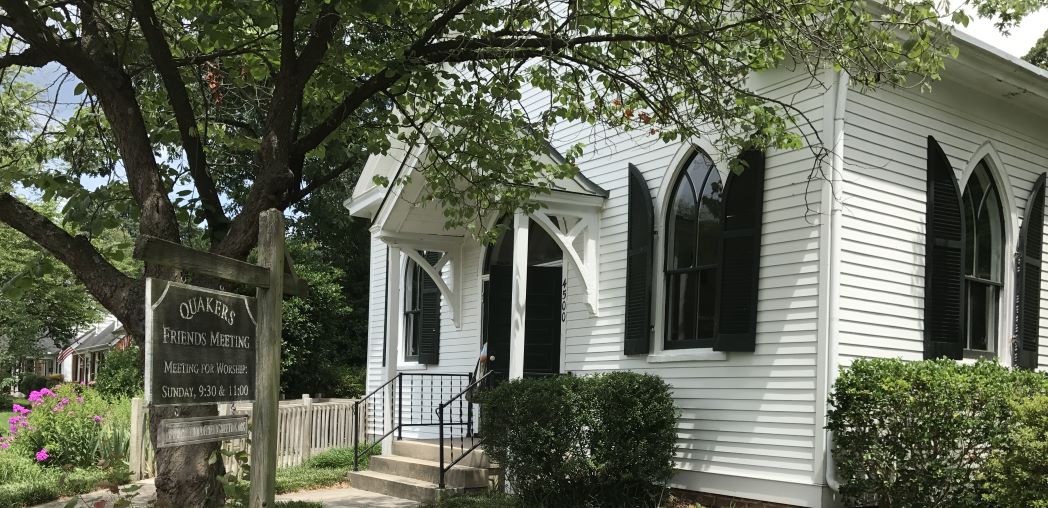
RFM purchased the 4500 Kensington Avenue property in 1957. (The Colonial Place Christian Church, an affiliate of the Disciples of Christ, built the original building in 1913. The educational annex was added in 1931.) The cost of the 4500 Kensington Avenue property in 1957 was approximately $17,500.
Deed of Sale 1956
RFM has provided office and meeting space to hundreds of community groups. Religious groups that have used the 4500 Kensington Avenue property for their programs include the Congregation Or Ami, the Metropolitan Christian Church, an unaffiliated Roman Catholic group and Muslims.
In the 1960s, RFM provided office and meeting space to the Richmond Area Association for Retarded Children. In 1967, RFM provided office space and volunteer support to the statewide antiwar Vietnam Summer Project. In 1971, RFM provided office space to the statewide Virginia Council for Human Relations until the Richmond Zoning Board opposition and a neighborhood petition of 1,200 signatures forced the interracial organization to relocate.
See below for a slide show of History of Quakers in Central Virginia
by WebPost | Dec 18, 2008 | History - RFM
- Richmond Friends Meeting (RFM) organized in 1795, and soon built its first Meeting House at 19th and Cary Street in Church Hill. This was the second oldest “church” in Richmond. We have a long history of religious observance and social justice within the Richmond community. In 1995, we celebrated our 200th birthday.
- Richmond area Quakers established the Virginia Abolition Society in 1790. With the Civil War, RFM established the Friends Asylum for Colored Orphans, now called the Friends Association for Children. After slave emancipation, RFM member Sarah Smiley and other Quaker women helped start a school for over 1,000 free black adults and children in Richmond.
- RFM purchased the 4500 Kensington Avenue property in 1957. (The Colonial Place Christian Church, an affiliate of the Disciples of Christ, built the original building in 1913. The educational annex was added in 1931.) The cost of the 4500 Kensington Avenue property in 1957 was approximately $17,500.
- RFM has provided office and meeting space to hundreds of community groups. Religious groups that have used the 4500 Kensington Avenue property for their programs include the Congregation Or Ami, the Metropolitan Christian Church, an unaffiliated Roman Catholic group and Muslims.
- In the 1960s, RFM provided office and meeting space to the Richmond Area Association for Retarded Children. In 1967, RFM provided office space and volunteer support to the statewide antiwar Vietnam Summer Project. In 1971, RFM provided office space to the statewide Virginia Council for Human Relations until the Richmond Zoning Board opposition and a neighborhood petition of 1,200 signatures forced the interracial organization to relocate.
- Since 1957, RFM has provided financial assistance and social support to Russian, Vietnamese, Cambodian and Central American refugees, who have relocated to the Richmond area.
- The 4500 Kensington Avenue property has been the site of countless weddings and memorial ceremonies, not only of Friends but also from the community at large.
- In 1986, RFM, overflowing with new attenders, established new worship groups in Ashland and Midlothian. Midlothian has since become a full-fledged meeting.
See below for a slide show of History of Quakers in Central Virginia
by WebPost | Dec 20, 2007 | Writings - Quaker Bibliography
Friends for 350 Years
BY HOWARD BRINTON, WITH AN HISTORICAL UPDATE BY MARGARET HOPE BACON
Overview of basic Quaker understandings and practices. Topics covered include the light within, meeting for worship, vocal ministry, reaching decisions, the meeting community, the meeting and the world, the four periods of Quaker history, and Quaker thought. Pendle Hill 2002 348 PP. Paper $16.00
Quaker Spirituality: Selected Writings
EDITED BY DOUGLAS STEERE A comprehensive collection of Quaker writings including George Fox, Isaac Penington, John Woolman, Caroline Stephen, Rufus Jones and Thomas Kelly. The introduction is a thoughtful brief history of Friends. Paulist Press 1984 334 PP. Paper $24.95
There is also an abridged edition. HarperSanFrancisco 2005 128 PP. Paper $11.95
The introduction can be purchased separately. Philadelphia Yearly Meeting 1988 56 PP. Paper $3.95
Encounter with Silence: Reflections from the Quaker Tradition
BY JOHN PUNSHON ”He presents the uniqueness of Quaker faith and practice while also relating it to the tradition of Christian spirituality.” -Parker J. Palmer
Friends United Press/Britain Yearly Meeting 1987 131 PP. Paper $12.00
Quaker Reader
EDITED BY JESSAMYN WEST Popular anthology of Quaker writings (1650-1960). Writings represent a wide range of perspectives; includes fine biographical notes at the beginning of each passage. An excellent and deep survey of Friends’ thought. Pendle Hill 1990 540 PP. Paper $17.50
Beyond Consensus: Salvaging Sense of The Meeting
BY BARRY MORLEY “In seeking the sense of the meeting we open ourselves to being guided to perfect resolution in the Light, to a place where we sit in unity in the collective inward Presence. Through consensus we decide it; through sense of the meeting we turn it over, allowing it to be decided.”
Pendle Hill 1996 32 PP. Paper $4.00
Beyond Majority Rule: Voteless Decision Making in The Religious Society Of Friends
BY MICHAEL J. SHEERAN
Michael Sheeran, a Jesuit scholar, studied the actual decision making process used among Friends. This book is the result of his study and he includes detailed descriptions of the process at work and draws conclusions about what works well and what does not. Philadelphia Yearly Meeting 1983 153 PP. Paper $12.00
Portrait in Grey: A Short History
BY JOHN PUNSHON
Traces the beginnings of the Religious Society of Friends, its distinctive way of life, and its explosive expansion in England and elsewhere. Britain Yearly Meeting 1984 293 PP. Paper $16.50
Silence And Witness: The Quaker Tradition
BY MICHAEL L. BIRKEL This is a new, meaty and inviting introduction to Quaker thought and spiritual life. The chapter entitled ‘The Facing Bench’ lifts up well selected quotations of prominent Friends on topics such as ‘The Immediate Presence of God,’ ‘The Universal Light of Christ,’ and ‘The Spiritual Basis of Peace.’ His chapter on the inward experience of worship is both an excellent introduction and a seasoned examination of centering techniques. Orbis 2004 144 PP. Paper $16.00
Essays On The Quaker Vision Of Gospel Order
BY LLOYD LEE WILSON Essays address facets of Quaker faith and practice, articulating the ways in which Gospel order has shaped lives and beliefs of Friends. Wilson gives the reader both a historical perspective and a contemporary understanding of basics like meeting for worship and for business, spiritual gifts, leadings and ministry. Seasoned Friends and those new to Quakerism will find much to ponder. Quaker Press of FGC 2002 200 PP. Paper $17.00
The Testimony Of Integrity
BY WILMER COOPER The call for integrity in daily life lies at the heart of Quakerism. It reflects Friends devotion to truth, honesty, authenticity, and wholeness. This pamphlet claims that the Testimony of Integrity should undergird all the Quaker testimonies and should become the guiding principle for daily living. Pendle Hill 1991 32 PP. Paper $4.00
Listening To The Light: How To Bring Quaker Simplicity And Integrity Into Our Lives
BY JIM PYM This book is an essential contemporary introduction to Quakerism written by a noted British Friend. Using many quotations from Britain Yearly Meeting’s Faith and Practice and other prominent sources, Pym summarizes Quaker thought and spiritual practice without over-simplifying it. Rider Books 1999 192 PP. Paper $16.95
Faith In Action: Quaker Social Testimony
ESSAYS BY JONATHAN DALE AND OTHERS.
Where do we stand on lived witness, on social testimony? Both in the essay by Jonathan Dale and the short contributions from many Friends, we get a glimpse at other people’s experience of the living truth. As Jonathan Dale says, “The more the Light is followed, the deeper the joy and the readier we may be for the next step.” This book will inspire readers to think about how we live out our testimonies in our lives, develop a culture of mutual accountability, and share the lessons from our journeys. When we say God is love, the integrity of our claim is known by the degree to which it is lived out in our lives. Britain Yearly Meeting 2000 292 PP. Paper $20.00
Faith and Practice of Baltimore Yearly Meeting
Baltimore Yearly Meeting’s book of discipline. Baltimore Yearly Meeting 1988 Paper $13.50
Pricing listed may not be current.
The above may be purchased at:
Friends Book Store
Pendle Hill Books
Baltimore Yearly Meeting Publications
Philadelphia Yearly Meeting Publications
by WebPost | Dec 21, 2004 | History - RFM
RICHMOND FRIENDS MEETING
Building Committee Request
Approved by the
Financial Stewardship Committee
To be recommended to Meeting for Business
on December 19, 2004
The Building Committee, requests that Financial Stewardship consider and recommend to the next Meeting for Business on December 19, 2004, a $43,000 increase in the construction budget for the Religious Education Building. This increase will be used to solve two major problems that have been encountered during the early stages of construction. If approved, the overall budget for the expansion and renovation of the RE Building would increase from $590,000 to $633,000.
The first problem is the need to replace the first floor of the Religious Education Building. When holes were dug to tie the foundation of the addition to the existing building, the builders discovered that our existing floor consists of only one inch of a mortar-like material over one inch of gravel. (Apparently they were cutting corners in 1937). This floor should be removed and replaced with four inches of gravel and four inches of concrete. The cost for removal and replacement is approximately $30,000. Labor costs are high for this change order because it is not feasible to bring large power equipment into the building to dig up the old floor. A new floor will solve many of the moisture problems we have experienced over the years–a problem we would have had to address with or without this renovation.
The second problem concerns the elevation of the outdoor meditation area and the need to prevent flooding in the stairwell of the new side door of the multipurpose room. The builder and architect tell us the elevation of the meditation patio needs to be raised by ten inches to ensure that water drains away from the building. An additional step will have to be added to the stairwell. A new retaining wall will be constructed along with a concrete swale to drain water out to Kensington Avenue. In addition, the existing ramp for persons with disabilities will receive a new foundation. The total cost of these changes totals $13,000. (Note: we do wonder why these elevation and drainage issues were not identified prior to construction. We will address this with the architect in our next meeting.)
When we began the construction phase of this project, we had a contingency fund of $30,000 to pay for unexpected expenses. As one can see, the two problems discussed above clearly exceed this amount. In addition, there are other expenses we have incurred or expect that will be paid from the contingency fund. For example, we had to employ an independent, engineering firm to test the steel and concrete at critical stages of construction, and we have asbestos in our window glazing, floor tiles, and glue that must be removed by a specialized company. The good news is that there is no asbestos in our ceiling tiles and glue.
There is some urgency in our deciding how best to handle this situation. If we choose not to increase our budget, we will have to delete something from our current design. The only line items the Building Committee could identify were the replacement windows on the second floor of the RE Building, the new insulation for the north wall, and the drywall over that insulation. Cost savings by eliminating these items would be about $22,000. If we choose this path, we need to inform Century Construction this coming week so they will not order the replacement windows for the second floor. The downside of this choice would be our missing the opportunity to achieve new energy savings. If we replace these windows at a later time, the costs will be more, and we would have to move out of the RE Building a second time. We do not recommend this course of action.
It should be noted that the Building Committee is asking for permission to spend an additional $43,000 only if absolutely necessary. The estimates for the proposed work were made on the high side, and thus, we are hopeful that the actual costs will be less. We are looking for some cost savings during construction in the electrical area where we may have more in the budget than actually required. There also may be more money in the budget for furnishings than needed. Another possibility to reduce the amount we have to borrow is to ask Building and Grounds to spend some of our major maintenance funds to pay for part of the new floor.
Below are the construction and contingency budgets and along with the charges to the contingency budget to date plus anticipated charges.
Construction Budget $440,503
Contingency Budget $30,000
Anticipated charges to contingency other than the floor ($30,000) and meditation area drainage problem ($13,000)
Engineering inspections and tests $6,000
Hardware for one-hour fire doors 8,000
Undercut for foundation tie-in 1,500
Asbestos removal (floor tiles, window caulk) 5,000
Total to date $20,000
In summary, if this request is approved, we are authorized to spend up to $43,000 to replace the first floor in the RE Building and make the changes in the meditation area to prevent flooding. This increase will allow us to proceed with our plans to install replacement windows, new insulation, and drywall on the second floor of the RE Building. We will be able to meet the contingencies we have already encountered and still have $10,000 remaining in our contingency fund. The Building Committee recommends the approval of this request in a timely manner to avoid delays in the construction schedule and increased costs.
Submitted to Financial Stewardship on December 12, 2004, on behalf of the Building Committee by Howard Garner, Clerk of the Construction Subcommittee.
by WebPost | Dec 18, 1969 | History - RFM
1963 There is no mention of specific membership numbers in the minutes but it appears the Meeting had very few members during the 1960s. ( An influx was seen in the 1970s.)
Robert Clark, Clerk
Most of the Meeting for Business Notes are penciled notes for the 1960s.
January:
- RFM responsible for service at the Confederate Chapel for 4th month. Bob Clark on committee to plan; Harry Wilbur led service
- Concern raised that RFM did not have any positive program of action
- RFM will write AFSC and ask how they might help in Prince Edward County with closing of public schools due to massive resistance.
- Art Spangenthal added to Peace and Social Concerns Committee
February:
- AFSC answered letter but offered no suggestions other than request for donations
March:
- Richmond Area Association for Retarded Children uses building for their program; their new building is being built
- Meeting agreed to educate youth re choice of being conscientious objector in response to House (in Congress) passing extension of draft bill
June:
- Committee of Peg Spangenthal and Christopher Rigby appointed to look into how RFM might help childcare centers in Richmond
August:
- Committee appointed to look into purchase of new hymnbooks
- Art Spangenthal asked to compose letter commending action to give free schooling in Prince Edward Count. It will be sent to newspapers.
- Two day work camp held at the Educational Therapy Center, which serves severely disturbed Negro children. Work camp was quite successful.
September:
- Prince Edward Foundation is asking for funds. RFM decided to send all donations so marked from members of RFM
- Proposed budget for 1964 was $2770
1964
August
- Refugee English class starts at Meeting house
1965 and 1966 Jay Worrall, Clerk
Feb 12, 1965:
- Nancy Adams of AFSC staff will speak on Brotherhood Day at RFM. She will talk about AFSC project in Prince Edward County. No press please.
- VA Council on Human Relations uses RFM building for program. (A contract between two groups for responsibilities is included in minutes.)
- 1966 Proposed budget $3090
January, 1966:
- VA Council of Human Relations has reported problem of using the building to their lawyer and a hearing is ser for March 2. We are to appoint our rep to this meeting.
- AFSC letter re Prince Edward AFSC project to Mary Hulbert has few suggestions to consider next meeting. AFSC says need is for money and people, not clothing.
Feb 2, 1966
- Something is going on in Meeting and there will a meeting with Mr. Kennedy. Sounds like neighbors are dissatisfied with VCHR . Letters included.
Feb 27, 1966
- Richmond Council of Peace Education given permission to have business sessions at Meeting once a month.
- RFM agrees to give up saving green stamps for piano since we aren’t getting there fast enough
- RCHR (RFM agrees) to allow them to host several tutorial programs and will use RFM twice a month for several months to evaluate their programs.
March, 1966
- Petition hearing on application for permit for VA Human Relations Council to continue in our building resulted in denial of permit. In compliance with the ruling, they moved back to old address at 17. E. Cary Street.
- Baltimore Yearly Meeting Young Friends will have their Easter Conference in Richmond April 15. A work program is to paint cabins at Camper Baker, which is used for campers of mentally retarded children. They will supply paintbrushes and adult superviosn. 45 young Friends attended despite cold weather.
April 1966
- Jay Worrall reported that Peace and Social Concerns had discussed the idea of a meeting on the God is Dead Theory, but members were not in favor of such a meeting.
May, 1966
- RFM decided to make Pendle Hill pamphlets available without charge but to leave a basket for those who wished to contribute.
- RFM agreed to pay $5 of $25 subscription for Washington Post for a conscientious objector at federal prison in Petersburg. The rest is to be paid by individual contributions.
- The lawn will be cared for this summer with the Spanthenthals providing the mower and the Hulburts the labor.
July, 1966
- Bob Clark will serve as Clerk with Jay Worrall’s resignation. (Jay and Carolyn moved to Charlottesville?)
1967
Robert Clark, Clerk
April, 1967
- There is considerable concern expressed over the seeming lack of unity and dedication to the Meeting by some of the members. It was felt that this concern should be given prayerful consideration by all members and by the Committee on Ministry and Counsel.
May, 1967
- Mary Hulbert, member of Peace and Social Concerns, asked that our building be made available for the summer months for a Vietnam Summer Project by a number of organization in cluding AFSC. The Meeting approved.
- RFM assisted a refugee family, under sponsorship with Church World Service, with $ and other assistance. Minutes over several years indicate that this family (from eastern Europe) was not easy to work with. RFM eventually terminated relationship. References to this family, problems encountered and the RFM struggle to help are referred to numerous times in the minutes. The name is not mentioned here since the family may still reside in Richmond and we wish to protect their privacy. 1968 RFM owes $90 to owner who rented the house to our refugee family to cover repairs. Owner will pay remainder. RFM assisted this family, under the sponsorship of Church World Service, for several years with money and assistance. The family left the basement of the house ½ full of clothing, which will be donated, to Church World Service. (This was not an altogether successful project as the family had difficulty in accepting American ways of heating, keeping daughter home to work in household instead of sending her to school, etc.)
September 1967
- A certificate of occupancy must be filed with city.
- RFM agreed that Ministry and Counsel send 2nd letter asking non-attending members if they wish to be dropped from roll. A second letter will also be sent to those who replied to first letter, saying how happy we are that they have expressed interest in remaining involved. Ministry and Counsel asked to make revision of membership a yearly task.
November, 1967
- Attorney says code does not require certificate of occupancy. RFM will write City of Richmond.
- The meal for the Christmas carol sing will be ham, sweet potatoes, two jello salads (one red and one green), rolls, and coffee. Red and green candles will be used for table decorations.
1968
Rowland Leonard, Clerk
- Prepared 1st Friends of report on state of society for 1967-68.
- Agreed to purchases another piano for no more than $100
- Christian Education reported a new project would start March 1 with a family first day. The AFSC project is to support a day care center in Vietnam. A special meeting called shortly thereafter this meeting due to concerns since Friends have always helped on both sides of conflict that it was wrong for children to help one side. After much discussion it was decided to allow the project to continue but to point out to the children that we would like to help both sides but are limited by laws of government for helping on North Vietnam. It was hoped that all members would follow the guidance in deciding course for themselves. Children later held a yard sale to raise money for the AFSC project.
- Baltimore Youth Conference held at RFM with 17 attendees who slept in Meeting and had work project with Neighborhood Center of the Richmond Community Action Project. .
- Social Concerns reported that Fair Housing conference will be April 12. We are only one of sponsors. RFM purchased 100 Pendle Hill pamphlets to distribute.
- Piano found for $295, not $100, to be paid on an extended plan so not to deplete our account.
May 1968
- Peace and Social Concerns has arranged a series of group dinners with the Woodville church to talk about the whole black-white situation. Food will be served first. Later reported that evening series was going very well.
- Indian Affairs Committee has collected about $215 in our annual “Buffalo Nickel” drive. A picnic at Pamunkey Indian Reservation is coming up and we will be invited.
September, 1968
- Piano has sticking keys. Treasurer asked to see about repair before making final payment.
- Concern expressed that only $1300 has been received thus far this year. Budget is $2880.
October, 1968
- RCAP budget being cut. RFM asked to support; sent $10. FRM will write letter for newspapers in support of Richmond Community Action Program.
- Concern raised again being “chained” to a building. Social Concerns will prepare a plan of what RFM should be doing. A special meeting will be called of members to discuss the proposed plan and the future of the Meeting.
November, 1968
- Treasurer reported we may weather the storm financially until first of year.
- RFM agreed to send letters to Sears and Salvation Army for their stand in doing no ads for war toys this year. Copy will be sent to newspapers also.
December, 1968
- RFM laid down annual lecture organized by the Ricks Memorial Lecture committee, realizing that we can revise it in future if deemed advisable.
- Fire escape still needs repair.
January 1969
Clerk, Jessie F. Hartley
NO RECORDS INCLUDED FROM 1969-1974.
- 1973 has $2675 budget with breakdown. No other records.
Prepared by Betsy Brinson, Ph.D.
RFM Historian
May, 2003