by WebPost | Mar 24, 2022 | Announcement
Friends Association for Children is celebrating their 150th anniversary with a number of events this year. Because Richmond Quakers had a role in their founding just after the Civil War, they hope we can join in celebrating with them.
Information about upcoming 150th celebration events can be found at this website: https://friendsrva.org/150-2/
The first celebration will be held on Thursday, March 31, at 7:00 pm via livestream. This will be an evening of history, storytelling and music, including recognition of some founding partners. There is a $15 charge to gain access, and they are offering a $5.00 discount for Richmond Friends. You may purchase a ticket at the website above and, if you like, order food and/or beverage from the organization’s partners to enjoy while watching the show. To receive the
discount, please use this code, Society5, when registering.
Rising clerk Lynda Perry will be there in person; our historian Scott Selby has also been invited. We have recorded a congratulatory message from RFM that may aired on March 31, or later in the year. Lynda and Scott met with the executive director of Friends Association for Children, J. David Young, last month and shared what we know of the early history. Friends Janet Scagnelli and Elizabeth Smith helped in creating the message; Ada Hammer and Rita Willett helped with research.
by WebPost | Feb 15, 2011 | History - RFM
Richmond Friends Meeting (RFM) organized in 1795, and soon built its first Meeting House at 19th and Cary Street in Church Hill. This was the second oldest “church” in Richmond. We have a long history of religious observance and social justice within the Richmond community. In 1995, we celebrated our 200th birthday.
Richmond area Quakers established the Virginia Abolition Society in 1790. With the Civil War, RFM established the Friends Asylum for Colored Orphans, now called the Friends Association for Children. After slave emancipation, RFM member Sarah Smiley and other Quaker women helped start a school for over 1,000 free black adults and children in Richmond.
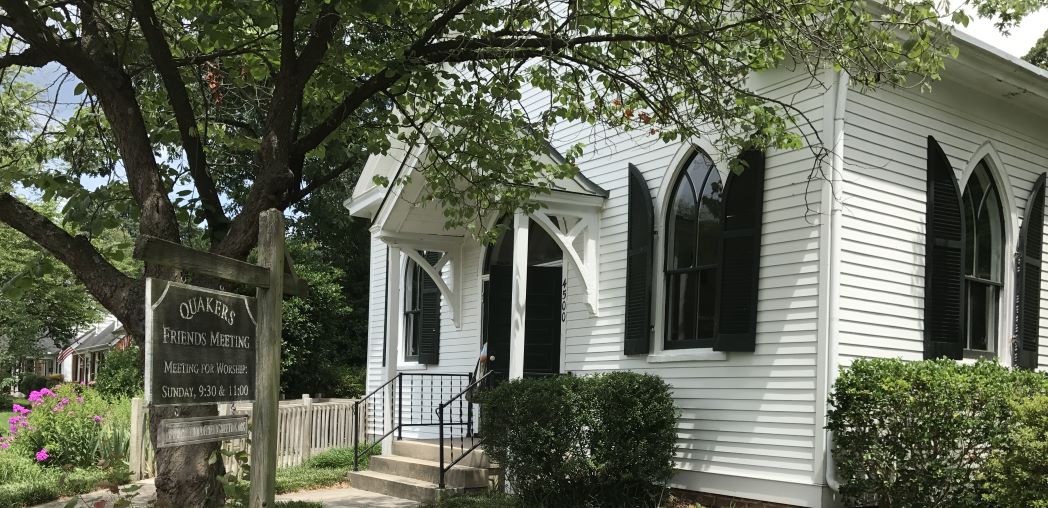
RFM purchased the 4500 Kensington Avenue property in 1957. (The Colonial Place Christian Church, an affiliate of the Disciples of Christ, built the original building in 1913. The educational annex was added in 1931.) The cost of the 4500 Kensington Avenue property in 1957 was approximately $17,500.
Deed of Sale 1956
RFM has provided office and meeting space to hundreds of community groups. Religious groups that have used the 4500 Kensington Avenue property for their programs include the Congregation Or Ami, the Metropolitan Christian Church, an unaffiliated Roman Catholic group and Muslims.
In the 1960s, RFM provided office and meeting space to the Richmond Area Association for Retarded Children. In 1967, RFM provided office space and volunteer support to the statewide antiwar Vietnam Summer Project. In 1971, RFM provided office space to the statewide Virginia Council for Human Relations until the Richmond Zoning Board opposition and a neighborhood petition of 1,200 signatures forced the interracial organization to relocate.
See below for a slide show of History of Quakers in Central Virginia
by WebPost | Dec 18, 2008 | History - RFM
- Richmond Friends Meeting (RFM) organized in 1795, and soon built its first Meeting House at 19th and Cary Street in Church Hill. This was the second oldest “church” in Richmond. We have a long history of religious observance and social justice within the Richmond community. In 1995, we celebrated our 200th birthday.
- Richmond area Quakers established the Virginia Abolition Society in 1790. With the Civil War, RFM established the Friends Asylum for Colored Orphans, now called the Friends Association for Children. After slave emancipation, RFM member Sarah Smiley and other Quaker women helped start a school for over 1,000 free black adults and children in Richmond.
- RFM purchased the 4500 Kensington Avenue property in 1957. (The Colonial Place Christian Church, an affiliate of the Disciples of Christ, built the original building in 1913. The educational annex was added in 1931.) The cost of the 4500 Kensington Avenue property in 1957 was approximately $17,500.
- RFM has provided office and meeting space to hundreds of community groups. Religious groups that have used the 4500 Kensington Avenue property for their programs include the Congregation Or Ami, the Metropolitan Christian Church, an unaffiliated Roman Catholic group and Muslims.
- In the 1960s, RFM provided office and meeting space to the Richmond Area Association for Retarded Children. In 1967, RFM provided office space and volunteer support to the statewide antiwar Vietnam Summer Project. In 1971, RFM provided office space to the statewide Virginia Council for Human Relations until the Richmond Zoning Board opposition and a neighborhood petition of 1,200 signatures forced the interracial organization to relocate.
- Since 1957, RFM has provided financial assistance and social support to Russian, Vietnamese, Cambodian and Central American refugees, who have relocated to the Richmond area.
- The 4500 Kensington Avenue property has been the site of countless weddings and memorial ceremonies, not only of Friends but also from the community at large.
- In 1986, RFM, overflowing with new attenders, established new worship groups in Ashland and Midlothian. Midlothian has since become a full-fledged meeting.
See below for a slide show of History of Quakers in Central Virginia
by WebPost | Dec 20, 2007 | Writings - Quaker Bibliography
Friends for 350 Years
BY HOWARD BRINTON, WITH AN HISTORICAL UPDATE BY MARGARET HOPE BACON
Overview of basic Quaker understandings and practices. Topics covered include the light within, meeting for worship, vocal ministry, reaching decisions, the meeting community, the meeting and the world, the four periods of Quaker history, and Quaker thought. Pendle Hill 2002 348 PP. Paper $16.00
Quaker Spirituality: Selected Writings
EDITED BY DOUGLAS STEERE A comprehensive collection of Quaker writings including George Fox, Isaac Penington, John Woolman, Caroline Stephen, Rufus Jones and Thomas Kelly. The introduction is a thoughtful brief history of Friends. Paulist Press 1984 334 PP. Paper $24.95
There is also an abridged edition. HarperSanFrancisco 2005 128 PP. Paper $11.95
The introduction can be purchased separately. Philadelphia Yearly Meeting 1988 56 PP. Paper $3.95
Encounter with Silence: Reflections from the Quaker Tradition
BY JOHN PUNSHON ”He presents the uniqueness of Quaker faith and practice while also relating it to the tradition of Christian spirituality.” -Parker J. Palmer
Friends United Press/Britain Yearly Meeting 1987 131 PP. Paper $12.00
Quaker Reader
EDITED BY JESSAMYN WEST Popular anthology of Quaker writings (1650-1960). Writings represent a wide range of perspectives; includes fine biographical notes at the beginning of each passage. An excellent and deep survey of Friends’ thought. Pendle Hill 1990 540 PP. Paper $17.50
Beyond Consensus: Salvaging Sense of The Meeting
BY BARRY MORLEY “In seeking the sense of the meeting we open ourselves to being guided to perfect resolution in the Light, to a place where we sit in unity in the collective inward Presence. Through consensus we decide it; through sense of the meeting we turn it over, allowing it to be decided.”
Pendle Hill 1996 32 PP. Paper $4.00
Beyond Majority Rule: Voteless Decision Making in The Religious Society Of Friends
BY MICHAEL J. SHEERAN
Michael Sheeran, a Jesuit scholar, studied the actual decision making process used among Friends. This book is the result of his study and he includes detailed descriptions of the process at work and draws conclusions about what works well and what does not. Philadelphia Yearly Meeting 1983 153 PP. Paper $12.00
Portrait in Grey: A Short History
BY JOHN PUNSHON
Traces the beginnings of the Religious Society of Friends, its distinctive way of life, and its explosive expansion in England and elsewhere. Britain Yearly Meeting 1984 293 PP. Paper $16.50
Silence And Witness: The Quaker Tradition
BY MICHAEL L. BIRKEL This is a new, meaty and inviting introduction to Quaker thought and spiritual life. The chapter entitled ‘The Facing Bench’ lifts up well selected quotations of prominent Friends on topics such as ‘The Immediate Presence of God,’ ‘The Universal Light of Christ,’ and ‘The Spiritual Basis of Peace.’ His chapter on the inward experience of worship is both an excellent introduction and a seasoned examination of centering techniques. Orbis 2004 144 PP. Paper $16.00
Essays On The Quaker Vision Of Gospel Order
BY LLOYD LEE WILSON Essays address facets of Quaker faith and practice, articulating the ways in which Gospel order has shaped lives and beliefs of Friends. Wilson gives the reader both a historical perspective and a contemporary understanding of basics like meeting for worship and for business, spiritual gifts, leadings and ministry. Seasoned Friends and those new to Quakerism will find much to ponder. Quaker Press of FGC 2002 200 PP. Paper $17.00
The Testimony Of Integrity
BY WILMER COOPER The call for integrity in daily life lies at the heart of Quakerism. It reflects Friends devotion to truth, honesty, authenticity, and wholeness. This pamphlet claims that the Testimony of Integrity should undergird all the Quaker testimonies and should become the guiding principle for daily living. Pendle Hill 1991 32 PP. Paper $4.00
Listening To The Light: How To Bring Quaker Simplicity And Integrity Into Our Lives
BY JIM PYM This book is an essential contemporary introduction to Quakerism written by a noted British Friend. Using many quotations from Britain Yearly Meeting’s Faith and Practice and other prominent sources, Pym summarizes Quaker thought and spiritual practice without over-simplifying it. Rider Books 1999 192 PP. Paper $16.95
Faith In Action: Quaker Social Testimony
ESSAYS BY JONATHAN DALE AND OTHERS.
Where do we stand on lived witness, on social testimony? Both in the essay by Jonathan Dale and the short contributions from many Friends, we get a glimpse at other people’s experience of the living truth. As Jonathan Dale says, “The more the Light is followed, the deeper the joy and the readier we may be for the next step.” This book will inspire readers to think about how we live out our testimonies in our lives, develop a culture of mutual accountability, and share the lessons from our journeys. When we say God is love, the integrity of our claim is known by the degree to which it is lived out in our lives. Britain Yearly Meeting 2000 292 PP. Paper $20.00
Faith and Practice of Baltimore Yearly Meeting
Baltimore Yearly Meeting’s book of discipline. Baltimore Yearly Meeting 1988 Paper $13.50
Pricing listed may not be current.
The above may be purchased at:
Friends Book Store
Pendle Hill Books
Baltimore Yearly Meeting Publications
Philadelphia Yearly Meeting Publications
by WebPost | Dec 18, 2000 | History - Quaker, Peace and Social Concerns
[Below a transcription of the 1802 Quaker petition against slavery presented to the Virginia legislature. Among those signing this petition are Samuel Parsons (the father of Samuel Pleasants Parsons, whose house survives at 601 Spring Street in Oregon Hill) and James Ladd (the uncle of Elizabeth Ladd, who married Samuel Pleasants Parsons).]
(Source: Miscellaneous Petitions to the Virginia Legislature, December 17, 1802. Archives of the Virginia State Library.)
To the speaker and House of Representatives of Virginia.
The memorial and petition of the religious Society of Friends.
Respectfully shew:
That your memorialists, estimating the importance of those concerns, which must necessarily engage the Legislature – feel no disposition to intrude upon your valuable time, or request your attention to subjects of a trivial nature but where grievances affecting any class of the community, arise from a partial construction of the laws, or exist because the laws have provided no remedy, we conceive it to be a duty, congenial with the spirit of legislation, and due to the House, faithfully to represent the same – and solicit such redress, as justice and equity require. Impressed with these sentiments- and feeling moreover the impulse of Religious duty, on behalf of the helpless, and unprotected – your memorialist beg leave to represent, certain cases of suffering, for which (in the opinion of some of the Courts) the laws have provided no effectual relief.
* Such we apprehend is the case of minor slaves, left free by will, but committed during their minority to the care of legatees – such minors notwithstanding their undoubted rights – and a clear conviction in the Courts of their claim to freedom – merely for the want of a legal prohibition – and on a ground of a temporary claim to their service – have been carried out of the State, and beyond the reach of testimony establishing their title – with the evident risk of being forever deprived of their freedom.
II Your memorialist beg leave further to represent that the practice of steeling, and selling free people of Color, continues to be carried on in some parts of the State; encouraged, we believe, by the little danger of conviction the law appearing to require evidence that free persons were stolen, or sold with a Knowledge of their being such. The difficulty, or rather their impossibility of adducing such evidence, we trust, will be sufficiently apparent, as well as the necessity of effectually restraining a practice which operates directly against the dignity of the Government – and contrary to the interest and spirit of the law, violates the first principles of justice with impunity. Your memorialist represent these subjects – with a full confidence that the justice, humanity, and sound policy of the Legislature will meet them with approbation. It cannot be supposed that the Representatives of a free, and enlightened people, can fail to appreciate the value of liberty, to whatever description of persons it may legally belong, or that they will not extend the barriers of the law around this inestimable privilege.
Interested as men and Christians, in the sufferings of our injured fellow creatures, and on behalf of numbers, who stand exposed to the same dangers – and may be involved in the same calamity – we therefore respectfully petition – That the law providing for the emancipation of slaves by will, and the law, respecting the stealing and selling free persons may be revised and amended – or that the legislature may make such provision for these cases as in their wisdom shall seem just and expedient.
Signed by order, and on behalf of the Representatives of the aforesaid Society
by James Ladd
Micajah Crew
Samuel Parsons
Jesse Copeland
Benjamin Bates Jr.
* See proviso to the law allowing emancipation. Abridgm’t of the permanent public laws, page 281.
II “If any person shall hereafter be guilty of stealing or selling any free person for a slave, knowing the said person so sold to be free, and thereof shall be lawfully convicted , the person so convicted, shall suffer death without benefit of Clergy.” Abridgment of the laws, page 280.
Friends Memorial. Mem. of L. to Riddick, Dupree, Dulaney, Allen, Sheffey, Shackelford, Aylett, Dunton, Jennings, Gee, Sebull, Blow, Josiah Riddick