by WebPost | Dec 18, 2008 | History - Quaker, Peace and Social Concerns, Testimonies, Writings - RFM
Friends affirm a Biblical basis for the peace testimony. A Prince of Peace was prophesied who would bring in a Peaceable Kingdom. “Thou shalt not kill” is one of the Ten Commandments. Jesus taught and lived peacemaking and love of enemy. George Fox similarly counseled his followers “to live in the life and power which does away with the occasion for war.”
The material below was prepared earlier by Mary Fran Hughes-McIntyre and is excerpted from her History of Richmond Friends Meeting, 1795-1962, available in the Meeting Library. (or here:THE HISTORY OF RICHMOND FRIENDS MEETING 1795-1962)
Living Out the Peace Testimony
Friends affirm a Biblical basis for the peace testimony. A Prince of Peace was prophesied who would bring in a Peaceable Kingdom. “Thou shalt not kill” is one of the Ten Commandments. Jesus taught and lived peacemaking and love of enemy. George Fox similarly counseled his followers “to live in the life and power which does away with the occasion for war.”
Early Richmond Friends were firm pacifists, disowning from membership those who bore arms. Doubtless knowing Friends from Cedar Creek Meeting who had firmly refused to fight during the Revolutionary War, Friends in Richmond affirmed a pacifist stand in the War of 1812. Friends suffered payment of muster fines rather than fight. As part of Virginia Yearly Meeting, they concurred with the following statement:
While we view with sorrow the awful progress of war spreading desolation and Misery in the human family, let us endeavor to guard our Minds from mixing in the politics of the times, which will insensibly leven into the spirit, and will lead if not to the practice at least to the promotion of that destructive evil.
During the War between the States, some Richmond Friends chose to fight, and some were conscientious objectors. Cedar Creek Monthly Meeting (of which Richmond Friends became a part in 1841) accepted the resignation of three persons who chose to fight, but “earnestly hopes that the day is not distant when those with many others aroused by the awful juncture of war now presented to our view may be enabled to renounce principles which lead to such results and enlist under the banner of the Prince of Peace.”
In the period from 1914-1920 the Peace Committee of Richmond Friends meeting was particularly active workingfor peace and reconciliation in the period of the Great War. Peace literature was distributed in the schools, and prizes were offered in 1916 for the best essays on “Why We Do Not Need a Large Increase in our Army and Navy”: $15 first prize to a boys’ school, $10 first prize to a girls’ school. (Editor: Friends have not been free from societal sexism and racism.) Money was donated for Belgian relief in 1914, for English and Armenian relief in 1916, for French orphans in 1917, and for feeding the German children in 1920. Letters were sent to Senators and Representatives in 1916 urging opposition to the so-called “preparedness” for war. The Friends Peace Committee ran two advertisements in the newspapers, including the following:
PEACE OR WAR?
To our fellow-citizens:
In this time of crisis when our country’s highest good is the common aim of all, we voice this deep conviction of patriotic duty.
The causes for which men fight—liberty, justice, and peace—are noble and Christian causes. But war itself violates law, justice, liberty and peace, the very ends for which alone its tragic costs might be justified…
In World War II, Friends were again active in peace-making. Member Hoge Ricks met at homes in 1940 with young Friends to think through their stands on the peace testimony in anticipation of their being faced with conscription. After the war opposition to conscription continued, with visits to Congressional Representative, and a firm stand against the Selective Service Act of 1948.
A change in Friends’ custom of disowning those who bear arms in evident in 1943. A member wrote saying that he had joined the Armed Forces as a result of personal conviction, and that he doubted the Meeting wanted his membership. The Meeting decided to stay in touch with him, since “to encourage him would do more that to ostracize him.”
(Richmond) Friends were proud of having several members, who were conscientious objectors, serving in Civilian Public Service Camps. Their peace testimony was affirmed.
Thus, Richmond Friends stood consistently against war, and dealt in increasingly lenient ways with Friends who chose to fight.
* * * *
(Editor: During World War II, some 12,000 men who were conscientious objectors to war, served in non-military occupations across the U.S. Under the leadership of Mennonite, Quaker and Church of the Brethren agencies, they were engaged in mental health care and medical experiments, in forestry and diary farming, and in other important civic projects.)
by WebPost | Dec 21, 2004 | History - RFM
RICHMOND FRIENDS MEETING
Building Committee Request
Approved by the
Financial Stewardship Committee
To be recommended to Meeting for Business
on December 19, 2004
The Building Committee, requests that Financial Stewardship consider and recommend to the next Meeting for Business on December 19, 2004, a $43,000 increase in the construction budget for the Religious Education Building. This increase will be used to solve two major problems that have been encountered during the early stages of construction. If approved, the overall budget for the expansion and renovation of the RE Building would increase from $590,000 to $633,000.
The first problem is the need to replace the first floor of the Religious Education Building. When holes were dug to tie the foundation of the addition to the existing building, the builders discovered that our existing floor consists of only one inch of a mortar-like material over one inch of gravel. (Apparently they were cutting corners in 1937). This floor should be removed and replaced with four inches of gravel and four inches of concrete. The cost for removal and replacement is approximately $30,000. Labor costs are high for this change order because it is not feasible to bring large power equipment into the building to dig up the old floor. A new floor will solve many of the moisture problems we have experienced over the years–a problem we would have had to address with or without this renovation.
The second problem concerns the elevation of the outdoor meditation area and the need to prevent flooding in the stairwell of the new side door of the multipurpose room. The builder and architect tell us the elevation of the meditation patio needs to be raised by ten inches to ensure that water drains away from the building. An additional step will have to be added to the stairwell. A new retaining wall will be constructed along with a concrete swale to drain water out to Kensington Avenue. In addition, the existing ramp for persons with disabilities will receive a new foundation. The total cost of these changes totals $13,000. (Note: we do wonder why these elevation and drainage issues were not identified prior to construction. We will address this with the architect in our next meeting.)
When we began the construction phase of this project, we had a contingency fund of $30,000 to pay for unexpected expenses. As one can see, the two problems discussed above clearly exceed this amount. In addition, there are other expenses we have incurred or expect that will be paid from the contingency fund. For example, we had to employ an independent, engineering firm to test the steel and concrete at critical stages of construction, and we have asbestos in our window glazing, floor tiles, and glue that must be removed by a specialized company. The good news is that there is no asbestos in our ceiling tiles and glue.
There is some urgency in our deciding how best to handle this situation. If we choose not to increase our budget, we will have to delete something from our current design. The only line items the Building Committee could identify were the replacement windows on the second floor of the RE Building, the new insulation for the north wall, and the drywall over that insulation. Cost savings by eliminating these items would be about $22,000. If we choose this path, we need to inform Century Construction this coming week so they will not order the replacement windows for the second floor. The downside of this choice would be our missing the opportunity to achieve new energy savings. If we replace these windows at a later time, the costs will be more, and we would have to move out of the RE Building a second time. We do not recommend this course of action.
It should be noted that the Building Committee is asking for permission to spend an additional $43,000 only if absolutely necessary. The estimates for the proposed work were made on the high side, and thus, we are hopeful that the actual costs will be less. We are looking for some cost savings during construction in the electrical area where we may have more in the budget than actually required. There also may be more money in the budget for furnishings than needed. Another possibility to reduce the amount we have to borrow is to ask Building and Grounds to spend some of our major maintenance funds to pay for part of the new floor.
Below are the construction and contingency budgets and along with the charges to the contingency budget to date plus anticipated charges.
Construction Budget $440,503
Contingency Budget $30,000
Anticipated charges to contingency other than the floor ($30,000) and meditation area drainage problem ($13,000)
Engineering inspections and tests $6,000
Hardware for one-hour fire doors 8,000
Undercut for foundation tie-in 1,500
Asbestos removal (floor tiles, window caulk) 5,000
Total to date $20,000
In summary, if this request is approved, we are authorized to spend up to $43,000 to replace the first floor in the RE Building and make the changes in the meditation area to prevent flooding. This increase will allow us to proceed with our plans to install replacement windows, new insulation, and drywall on the second floor of the RE Building. We will be able to meet the contingencies we have already encountered and still have $10,000 remaining in our contingency fund. The Building Committee recommends the approval of this request in a timely manner to avoid delays in the construction schedule and increased costs.
Submitted to Financial Stewardship on December 12, 2004, on behalf of the Building Committee by Howard Garner, Clerk of the Construction Subcommittee.
by WebPost | Dec 18, 2000 | History - RFM, Writings - RFM
By Donna Knicely, member of the History Committee
If you have lived in Richmond very long at all, you have probably heard of the Friends Association for Children. And, as a Quaker, you have probably wondered what the connection is between the two. The following history was provided by staff of the Friends Association for Children.
Friends Association, currently located at 1004 Saint John Street, was founded shortly after the Civil War. A group of black civic workers, the Ladies Sewing Circle for Charitable Works, recognized the need for an orphanage for black children who were left homeless following the War. Turmoil surrounding the abolition of slavery left many children in the Richmond area without parents, relatives or guardians.
Mrs. Lucy Goode Brooks, the Sewing Circle leader, convinced the members of her group that support was needed from community groups to undertake the project. She sought the endorsement and financial aid for the orphanage from the Richmond Society of Friends. It is believed that Society was approached because some members of the Sewing Circle had lived with Quaker families before and during the War and recognized their humanitarian interest in the less fortunate and oppressed. The group was also aware of the financial contributions Quakers had made to the education of black children in other communities.
Under the direction of John Baker Crenshaw, the Quakers became active in the effort to find relief for black orphans in Richmond. Mr. Crenshew was the minister of the Richmond Society of Friends and grandfather of former Judge J. Hodge Ricks of the Juvenile and Domestic Court. The Quakers agreed to sponsor the orphanage project and raised money in Virginia and in the Northern States. On August 12, 1867, the Richmond City Council voted to deed the “Old Orphan Asylum” lot at the corner of Saint Paul and Charity Streets to the Trustees of the Society of Friends for the construction of an orphanage for black children. The building was completed in 1871, and the Friends Asylum for Colored Orphans was incorporated by the Virginia General Assembly on March 26, 1872.
The organization was governed by white trustees until 1889. At that time, the composition of the Board of Trustees was altered to include only representatives of black, Richmond area Baptist churches. The number of trustees was determined by the financial support provided by each church. In recognition of this change, the Richmond City Council deeded the property to the Friends Asylum for Colored Orphans. Increased funding was granted to the Asylum in 1926 following a study by the Community Fund and the Child Welfare League of America, which concluded that the orphanage was vital to the city. After another study in 1929 it was determined that foster home care was more needed than an orphanage. In 1931 the orphanage was closed and the group became a foster care agency under the supervision of the Children’s Aid Society of Richmond.
In 1932 after separating from the Children’s Aid Society, the group was renamed the Friends Association for Colored Children. About this time services began to change in order to respond to the needs of the community. An adoption service was started in 1938 and a program providing counseling services to children in their homes was initiated in 1940. In 1947 Friends Association began the evolution of its current Child Care Program by opening the Community Day Nursery. In 1955 the foster care program was replaced by a pre-adoption boarding home and services for the unwed mother.
Today the Friends Association for Children is guided by three basic tenets: “child care is our business, the family is important to us, and we make it possible for children to reach their potential.”
![Chronology of Richmond Friends Properties and Locations]()
by WebPost | Dec 18, 2000 | History - RFM
1795 — “At a Monthly Meeting held at White Oak Swamp. 2nd day, 7th month, 1795. The members of Swamp Meeting were joined to Richmond Meeting which is to be held on First and Fourth days of the week, and to begin on the First Day the 15th of this month.” (Valentine Museum typescript, 1795) [See VA Historical Marker]
1796 — Minutes mention Friends in Richmond meeting in “the present room.” (Valentine typescript, 10th of 1 month, 1796)
— “At a Monthly Meeting held at White Oak Swamp 4th of the 6th mo. 1796. The Friends of Richmond through the channel of the Preparative Meeting requests the approbation of this Meeting to build a Meeting House there.” (Valentine type script, p. 254)
1797 — “11-4-1797 — The Committee appointed by last Meeting to consult with Friends of Richmond in respect to getting a more suitable lot there for the purpose of building a Meeting House, reported that they had attended to the service and fixed on one the lower side of Shockoe Creek which is procured for that purpose instead of the other one proposed; and the size of the house extended to forty feet square, which is in considerable forwardness, the completion whereof is left to the Committee appointed for that purpose.” (White Oak Swamp Monthly Meeting minute, summarized from Valentine typescript)
1798 — “At a Monthly Meeting at White Oak Swamp on 5th day of the 5th month 1798: Queries to Meeting — One new Meeting House built in Richmond.” (Summary of Valentine typescript, p. 281)

Mary Winston’s needlework thought to be in the first Friends Meeting House built by George Winston. It was embroidered by Mary Winston in 1806. The buildings near the bottom are two views of the Richmond Friends Meeting house located at 19th and Cary Street.
Contributed by Donna Rugg

Portrait of Hannah Watts Clarke, circa 1840, with first Richmond Friends Meetinghouse visible through window.
Hannah Watts Clark
1810 — The location of the meetinghouse is shown on the northeast corner of Cary and 19th Streets. (“Richmond Virginia in Old Prints,” Johnson Publishing Co., 1932,) p. 32.)
1819 — The Samuel Parsons House at 601 Spring Street was built from 1817 to 1819. The Parsons were members of the Richmond Meeting which met at 19th and East Cary Streets. Samuel Parsons was superintendent of the nearby Penitentiary during the 1820’s. The building later became Spring Street Home for Unwed Mothers, then harbored pensioners, then the Welfare Department. (M.W. Scott, p. 212)
1836 — “In 1836, the meeting house was so badly damaged by fire that it was necessary to appoint a committee to consider the matter of rebuilding…. It would seem from the records that $250 was received toward the rebuilding of the new meeting house. We suppose this amount was in addition to what was raised from the sale of the church property. At any rate, a new meeting house of frame, surrounded by a high brick wall, was built at the corner of 19th and Cary Streets, date not given.” (“Richmond Friends” by Matthew F. Woodard, 1929)
1853 — Description of the first meetinghouse: “Their earliest meetinghouse was of brick, with a graveyard just north of it….In 1853 a writer in the Dispatch described the rude building with its unpainted interior set in a graveyard without stones but covered with eglantine — an oasis in the desert of factories and warehouses.” (Scott, p. 67, citing the Richmond Times Dispatch June 15th, 1853.)
1862 — During the War between the States, the meetinghouse was forcibly occupied by Confederate troops. It was located between Castle Thunder (prison for Southerners) and Castle Libby (prison for Federal soldiers). It may have been used as a hospital, according to oral tradition. (Letter from Cedar Creek Monthly Meeting, 1st mo., 27th 1875, quoted below)
— The deed for the lot on 19th and Cary St. was sold, except the graveyard, in 1862. Three lots in Hollywood Cemetery numbered 121, 122, and 123 in Section L were purchased for $173 n 1863. (Cedar Creek Monthly Meeting Minutes, 1862, p. 218. Richmond Monthly Meeting Minutes, 9th month, 12th, 1894 p. 17)
1867 — “One building of a public character that survives is Springfield Hall…which was erected at 16th and M around 1850. Just after the Civil War the Society of Friends used this as its meetinghouse.” (Scott, p. 24. Picture is on p. 22.)
 Springfield Hall, 26th and M (700 26th Street), 1867-1868
l868 — Location of the meetinghouse built after the Civil War was on the south side of Clay Street, west of First. In 1955 it was still standing and used as the Moses Memorial Baptist Church. (Richmond Times-Dispatch July 17th 1955) Pictures of this meetinghouse’s interior are to be placed in the Quaker Collection, Haverford College.)
 9 East Clay Street, 1868-1909
1871 — Management of Friends Orphan House for Colored Children built by Friends (East corner of St. Paul Street and West Charity Street) after the Civil ended was officially offered to the colored churches of Richmond and Manchester. [See VA Historical Marker.]
1875 — “Cedar Creek Monthly Meeting of Friends, Richmond, Va. 1st Month, 25th, 1875 [See VA Historical Marker]. Dear Friends: Friends of the above Monthly Meeting earnestly solicit thy favorable consideration and pecuniary assistance in liquidating the liability incurred by the building of their new meeting-house. During the war the old meeting-house, situated betwixt Castle Thunder and Castle Libby, was forcibly taken possession of by the Confederate soldiery, and friends, after suffering much annoyance, found shelter for a while in a private house, and afterwards in a rented room. Before the close of the war the old meeting-house was sold for Confederate money, and the proceeds invested in railroad bonds, from which loss was sustained.. . .“ (Letter signed on behalf of Cedar Creek Monthly Meeting by John B. Crenshaw, et al)
1909 — The property on Clay street was sold, and meetings were held, for the most part, in the YMCA Building, second floor. (Woodard, p. 1)
1929 — Friends purchased a building “constructed of plain white stucco. It is quite attractive, because of its simplicity and beauty. The location is good being opposite a small park and in the midst of a very good residential section.” (Woodard, p. 1) This meetinghouse was located at the north east corner of Park and Meadow. (Ulrich Troubetzkoy, “The Society of Friends in Richmond,” Richmond Times Dispatch, 1955)
 1804 Park Avenue, 1929-1945
1943 — Friends met at Grace Covenant Presbyterian Church during the winter due to war—time fuel shortages. (Richmond Monthly Meeting Minutes, February 15, 1953)
1945 Sale of the Meetinghouse at 1804 Park Avenue at the north east corner of Park Avenue and Meadow Street, to Calvary Pentecostal Tabernacle of the Assemblies of God for $16,750 cash. Friends felt it inadvisable to buy another meeting house on the current market. (Richmond Monthly Meeting Minutes, 5-13-45, pp. 205, 208)
— Friends met In an annex on the east side of Tabernacle Baptist Church ‘ 115 Grove Avenue, or In the YMCA from l9 through 1953. (Richmond Monthly Meeting Minutes, February 15, 1953)
1953 — Friends met at 2702 Grove Avenue in a converted residence. (Richmond Monthly Meeting Minutes, December 7, 1952) This was sold because it did not meet fire regulations. (Jessie Frazer Hartley interview, April 8, 1979)
 2702 Grove Avenue, 1953-1957
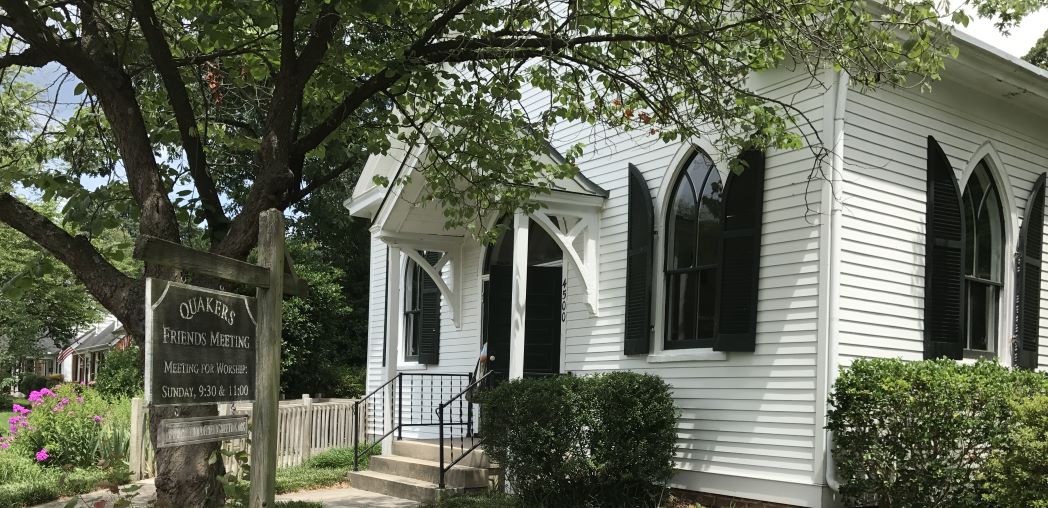
1957 — The current meetinghouse at 4500 Kensington Avenue was purchased from Colonial Place Christian Church. “The Meeting approves the minute that the Trustees of the Meeting be authorized to negotiate a real estate transaction for the sale of 2702 Grove Avenue at $16,500 and the subsequent purchase of 4500 Kensington Avenue at $l7,500, or otherwise, the transaction to be at any differential of $1000.” (Richmond Monthly Meeting Minutes, February 14, 1957)
 4500 Kensington Avenue, 1957-present

4500 Kensington Avenue Deed of Sale, 1957
[Narrative above from: Hughes, Mary Fran (1979). The History of Richmond Friends Meeting 1795-1962 (Appendix – Location of Richmond Friends Meetinghouses). Unpublished. Link to full document: THE HISTORY OF RICHMOND FRIENDS MEETING 1795-1962 ]