by WebPost | Dec 18, 1969 | History - RFM
1963 There is no mention of specific membership numbers in the minutes but it appears the Meeting had very few members during the 1960s. ( An influx was seen in the 1970s.)
Robert Clark, Clerk
Most of the Meeting for Business Notes are penciled notes for the 1960s.
January:
- RFM responsible for service at the Confederate Chapel for 4th month. Bob Clark on committee to plan; Harry Wilbur led service
- Concern raised that RFM did not have any positive program of action
- RFM will write AFSC and ask how they might help in Prince Edward County with closing of public schools due to massive resistance.
- Art Spangenthal added to Peace and Social Concerns Committee
February:
- AFSC answered letter but offered no suggestions other than request for donations
March:
- Richmond Area Association for Retarded Children uses building for their program; their new building is being built
- Meeting agreed to educate youth re choice of being conscientious objector in response to House (in Congress) passing extension of draft bill
June:
- Committee of Peg Spangenthal and Christopher Rigby appointed to look into how RFM might help childcare centers in Richmond
August:
- Committee appointed to look into purchase of new hymnbooks
- Art Spangenthal asked to compose letter commending action to give free schooling in Prince Edward Count. It will be sent to newspapers.
- Two day work camp held at the Educational Therapy Center, which serves severely disturbed Negro children. Work camp was quite successful.
September:
- Prince Edward Foundation is asking for funds. RFM decided to send all donations so marked from members of RFM
- Proposed budget for 1964 was $2770
1964
August
- Refugee English class starts at Meeting house
1965 and 1966 Jay Worrall, Clerk
Feb 12, 1965:
- Nancy Adams of AFSC staff will speak on Brotherhood Day at RFM. She will talk about AFSC project in Prince Edward County. No press please.
- VA Council on Human Relations uses RFM building for program. (A contract between two groups for responsibilities is included in minutes.)
- 1966 Proposed budget $3090
January, 1966:
- VA Council of Human Relations has reported problem of using the building to their lawyer and a hearing is ser for March 2. We are to appoint our rep to this meeting.
- AFSC letter re Prince Edward AFSC project to Mary Hulbert has few suggestions to consider next meeting. AFSC says need is for money and people, not clothing.
Feb 2, 1966
- Something is going on in Meeting and there will a meeting with Mr. Kennedy. Sounds like neighbors are dissatisfied with VCHR . Letters included.
Feb 27, 1966
- Richmond Council of Peace Education given permission to have business sessions at Meeting once a month.
- RFM agrees to give up saving green stamps for piano since we aren’t getting there fast enough
- RCHR (RFM agrees) to allow them to host several tutorial programs and will use RFM twice a month for several months to evaluate their programs.
March, 1966
- Petition hearing on application for permit for VA Human Relations Council to continue in our building resulted in denial of permit. In compliance with the ruling, they moved back to old address at 17. E. Cary Street.
- Baltimore Yearly Meeting Young Friends will have their Easter Conference in Richmond April 15. A work program is to paint cabins at Camper Baker, which is used for campers of mentally retarded children. They will supply paintbrushes and adult superviosn. 45 young Friends attended despite cold weather.
April 1966
- Jay Worrall reported that Peace and Social Concerns had discussed the idea of a meeting on the God is Dead Theory, but members were not in favor of such a meeting.
May, 1966
- RFM decided to make Pendle Hill pamphlets available without charge but to leave a basket for those who wished to contribute.
- RFM agreed to pay $5 of $25 subscription for Washington Post for a conscientious objector at federal prison in Petersburg. The rest is to be paid by individual contributions.
- The lawn will be cared for this summer with the Spanthenthals providing the mower and the Hulburts the labor.
July, 1966
- Bob Clark will serve as Clerk with Jay Worrall’s resignation. (Jay and Carolyn moved to Charlottesville?)
1967
Robert Clark, Clerk
April, 1967
- There is considerable concern expressed over the seeming lack of unity and dedication to the Meeting by some of the members. It was felt that this concern should be given prayerful consideration by all members and by the Committee on Ministry and Counsel.
May, 1967
- Mary Hulbert, member of Peace and Social Concerns, asked that our building be made available for the summer months for a Vietnam Summer Project by a number of organization in cluding AFSC. The Meeting approved.
- RFM assisted a refugee family, under sponsorship with Church World Service, with $ and other assistance. Minutes over several years indicate that this family (from eastern Europe) was not easy to work with. RFM eventually terminated relationship. References to this family, problems encountered and the RFM struggle to help are referred to numerous times in the minutes. The name is not mentioned here since the family may still reside in Richmond and we wish to protect their privacy. 1968 RFM owes $90 to owner who rented the house to our refugee family to cover repairs. Owner will pay remainder. RFM assisted this family, under the sponsorship of Church World Service, for several years with money and assistance. The family left the basement of the house ½ full of clothing, which will be donated, to Church World Service. (This was not an altogether successful project as the family had difficulty in accepting American ways of heating, keeping daughter home to work in household instead of sending her to school, etc.)
September 1967
- A certificate of occupancy must be filed with city.
- RFM agreed that Ministry and Counsel send 2nd letter asking non-attending members if they wish to be dropped from roll. A second letter will also be sent to those who replied to first letter, saying how happy we are that they have expressed interest in remaining involved. Ministry and Counsel asked to make revision of membership a yearly task.
November, 1967
- Attorney says code does not require certificate of occupancy. RFM will write City of Richmond.
- The meal for the Christmas carol sing will be ham, sweet potatoes, two jello salads (one red and one green), rolls, and coffee. Red and green candles will be used for table decorations.
1968
Rowland Leonard, Clerk
- Prepared 1st Friends of report on state of society for 1967-68.
- Agreed to purchases another piano for no more than $100
- Christian Education reported a new project would start March 1 with a family first day. The AFSC project is to support a day care center in Vietnam. A special meeting called shortly thereafter this meeting due to concerns since Friends have always helped on both sides of conflict that it was wrong for children to help one side. After much discussion it was decided to allow the project to continue but to point out to the children that we would like to help both sides but are limited by laws of government for helping on North Vietnam. It was hoped that all members would follow the guidance in deciding course for themselves. Children later held a yard sale to raise money for the AFSC project.
- Baltimore Youth Conference held at RFM with 17 attendees who slept in Meeting and had work project with Neighborhood Center of the Richmond Community Action Project. .
- Social Concerns reported that Fair Housing conference will be April 12. We are only one of sponsors. RFM purchased 100 Pendle Hill pamphlets to distribute.
- Piano found for $295, not $100, to be paid on an extended plan so not to deplete our account.
May 1968
- Peace and Social Concerns has arranged a series of group dinners with the Woodville church to talk about the whole black-white situation. Food will be served first. Later reported that evening series was going very well.
- Indian Affairs Committee has collected about $215 in our annual “Buffalo Nickel” drive. A picnic at Pamunkey Indian Reservation is coming up and we will be invited.
September, 1968
- Piano has sticking keys. Treasurer asked to see about repair before making final payment.
- Concern expressed that only $1300 has been received thus far this year. Budget is $2880.
October, 1968
- RCAP budget being cut. RFM asked to support; sent $10. FRM will write letter for newspapers in support of Richmond Community Action Program.
- Concern raised again being “chained” to a building. Social Concerns will prepare a plan of what RFM should be doing. A special meeting will be called of members to discuss the proposed plan and the future of the Meeting.
November, 1968
- Treasurer reported we may weather the storm financially until first of year.
- RFM agreed to send letters to Sears and Salvation Army for their stand in doing no ads for war toys this year. Copy will be sent to newspapers also.
December, 1968
- RFM laid down annual lecture organized by the Ricks Memorial Lecture committee, realizing that we can revise it in future if deemed advisable.
- Fire escape still needs repair.
January 1969
Clerk, Jessie F. Hartley
NO RECORDS INCLUDED FROM 1969-1974.
- 1973 has $2675 budget with breakdown. No other records.
Prepared by Betsy Brinson, Ph.D.
RFM Historian
May, 2003
by WebPost | Dec 18, 1967 | History - RFM, Peace and Social Concerns, Testimonies
One of the most divisive events in 20th century U.S. history was the war in Vietnam. The antiwar movement gained national prominence in 1965, peaked in 1968, and remained powerful throughout the duration of the conflict. In June 1967, in keeping with our position against war, the Richmond Friends Meeting hosted in our Kensington Avenue building the office for the Vietnam Summer Project, a statewide program opposing U.S. involvement in Vietnam.
In June 1967, in keeping with our position against war, the Richmond Friends Meeting hosted in our Kensington Avenue building the office for the Vietnam Summer Project, a statewide program opposing U.S. involvement in Vietnam. Phyllis Conklin and Marii Hasegawa, representing the Women’s International League for Peace and Freedom, led the statewide Vietnam Summer Project. (The Richmond WILPF chapter, newly organized by Phyllis and Marie, had about ten active members.) Some Richmond Friends Meeting members were also active in the Vietnam Summer Project along with other community individuals, who opposed the war.
Ben Ragsdale, a young student, was hired to help coordinate the program, which had groups in Norfolk, Hampton, Northern Virginia, Charlottesville, Lexington, Roanoke and Farmville. Ben recalls doing a lot of moving around the state. He indicates that the college campuses were not as active as they were later because it was the summer and students were not in attendance. He also recalls receiving a small paycheck every two weeks.
The Vietnam Summer Project attempted to host a peaceful antiwar rally at the Richmond War Memorial but was denied a permit. The ACLU filed an injunction against the ruling, which found them before the newly installed Judge Mehrige in federal court. Judge Mehrige told them that it was a constitutional issue and refused an injunction until the case could be heard in federal court. When Phyllis and Marii protested that this was a one summer’s protest project and the convocation was to be the end of it, Judge Mehrige told them that he was certain there were enough concerned people to keep the group alive until the case could receive a proper hearing. Bob Conklin recalls that while the Judge was in favor of granting the permit, he delayed the opinion in part because of his newness on the bench and the public controversy over the war itself. The 1967 peace rally was held instead at Union Seminary. The court eventually ruled in favor of the Vietnam Summer Project and the peace rally at the War Memorial finally happened a year later with several hundred in attendance.
Minutes of the Richmond Friends Meeting show that the City of Richmond intervened in the Vietnam Summer Project by sending a letter to Meeting, arguing that we did not have a permit for allowing our building to be used for such a purpose. Since the Meeting had for years allowed numerous groups supporting a wide variety of social issues to use RFM for meetings and office space, we can conjecture that this time the city objected because the war was so divisive in the public mind. The Business Meeting though simply agreed to pay for the permit. Ben Ragsdale and Marii Hasegawa do not recall ever knowing about the permit issue so it may well be that the Meeting quietly went ahead and did their part to help the project without concerning others.
RFM member Peg Spangenthal recalls that her husband Art, who served in Italy in World War II, offered counseling to young men concerned about the draft. She remembers hosting groups at their home, where materials were distributed and young men role-played the offered advice. We believe that Jules Arginteanu from the Meeting also offered draft counseling.
Other project activists spoke to church and college groups and responded to media inquiries about why the war in Vietnam was wrong. Bob Conklin recalls attending a meeting at the Unitarian church, where right-wingers blocked the entrance and the hallways, pushing their cameras to within inches of antiwar activist faces before blinding them with flashes. The right-wingers were anxious to rough it up and antiwar activists expected worse. During the meeting, Bob recalls that the debate centered on who eventually should govern Vietnam. A woman, sensing that Phyllis Conklin would favor the Communists, asked, ” Who is there but the Communists to give it to?” Phyllis’s response was “Why, to the people, of course.” As a result, antiwar activists were not hassled on the way out.
Later the police planted an “informer” in the project. “Ed,” as he was known, was apparently a little too enthusiastic about his new mission. He was very anxious to help with mailings, because he wanted to obtain the WILPF mailing list. Organizers were able to put him off and give him inconsequential jobs. Later that year at a City Hall demonstration, members of the group recognized “Ed”—this time dressed in his police uniform. They had a good laugh as one after another they called out, “Hi, Ed!” Ben Ragsdale recalls another plainclothesman, who appeared at project events. His name was Ricky Duling and he eventually became “Sergeant Santa” at Christmas to area children.
This was also the beginning of the Friday peace vigils at the post office. For four years, Phyllis Conklin and other sturdy souls leafleted in opposition to the Vietnam War. In doing this, they were called many names. Phyllis loved to tell that hostility changed to curiosity and even some interest and support as the national challenges to the war increased. She told about a man who stopped her toward the end of the four years and said that he had been watching them all this time. In the beginning he thought they were crazy, but gradually over the years his attitude had changed and now he really admired their perseverance.
Marii Hasegawa recalls that Richmond Friends Meeting played an important role by providing office space and volunteer support. She also recalls that the key to the side door was often very hard to turn and hopes that we have repaired it.
Thanks to Marii Hasegawa, Bob Conklin, Wendy Northup, Ben Ragsdale, Peg Spangenthal, Ann Lane and others who offered information for the above story. Phyllis Conklin died in 1987. Marii Hasagawa, now age 84, resides in a retirement community in South Hadley, Massachusetts. She continues to be active in social justice issues and sends greetings to all her Richmond friends. Ben Ragsdale is presently the director of the Virginia Civil Rights Video Initiative. Betsy Brinson is responsible for the research and writing of this short article. Readers who have additional information to share about the Vietnam Summer Project are invited to contact her at brinson422@comcast.net

by WebPost | Dec 18, 1962 | History - RFM, Writings - RFM
THE HISTORY OF RICHMOND FRIENDS MEETING
1795–1962
by
Mary Fran Hughes
Richmond, Virginia
1979
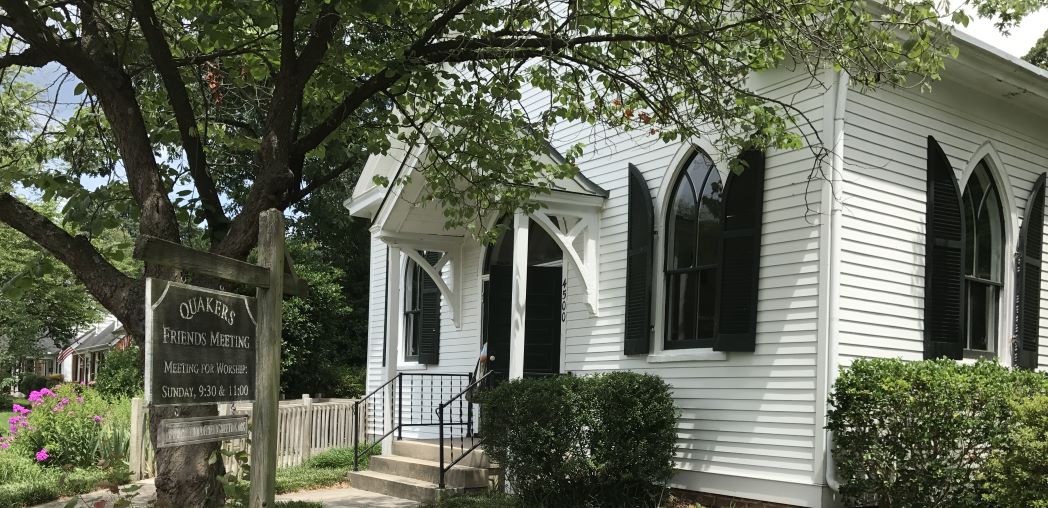
Since joining Richmond Friends Meeting in 1976, I have wondered about the history of my new spiritual family. A sense of our history might give us an appreciation for who we are and can become. Realizing that hardly any of the present active members had been in the Meeting prior to 1960 left me wondering about the danger of our being cut off from our heritage — no one even seemed to know how long it stretched back. (Photo 2003)
My interest was encouraged by Jay Worrall, official historian for Virginia Friends, who generously opened his card files on Virginia Friends’, history. Patricia Hickin, a historian who has worked with the Virginia State Library, likewise shared her historical resources and her enthusiasm for the project. Eda Martin whose interest in family history led to study of Quaker ancestors in Richmond Friends Meeting brought forth notes, books, watercolor portraits, a pilgrimage to Friends’ graves in Hollywood Cemetery, and a deep concern for historical accuracy. The occasion for the history-writing was James Smylie’s American Religious History course at Union Theological Seminary. His insistence that I learn about the broader contexts of Virginia, Richmond, national, and American religious history added depth and occasional discoveries about the topic itself. These persons and William McIntyre read the following history and offered editorial suggestions.
Discovering a history which went hack all the way to 1795 and which was passed down through a single family for about 150 years was breath-taking. With the Meeting’s current Friends General Conference (more Hicksite) orientation, we have a long heritage of Orthodoxy through the lifetime of the Crenshaw family in the Meeting. Our testimonies on peace and reform of the social order have been faithfully lived out as Friends have met silently to wait upon the Lord. From worship came fresh strength and perspective.
Since no systematic history of Richmond Friends Meeting has been previously written, I feel a responsibility to choose themes and to organize them in a way which grows out of the history itself. The hope is that contemporary and future Richmond Friends may gain insight through what has been lived out before. Yet, the focus is on issues alive today. With the current efforts to revive the draft, I have focused on our pacifist history which responded to each war or rumor of war with a peace-making stand. The Meeting’s recent sponsorship of eleven Cambodian refugees is in harmony with Friends testimony on race relations and the abolition of slavery. As we wrestle with our ministry in the prisons and in opposition to capital punishment, we look to our predecessors who did likewise.
May our history move us to “walk cheerfully over the world, looking for that of God in every person.”
Read full paper (PDF)…. THE HISTORY OF RICHMOND FRIENDS MEETING 1795-1962
by WebPost | Dec 21, 1930 | History - RFM
Where the Money Went
A Brief Look at Richmond Friends’ Spending
In the Early Years of the Last Century
The responsibility of a treasurer is to keep careful track of the money coming into and going out of an organization. But the legacy of a treasurer also can be a rich historical record of the values and behavior of a group of people. What a society values is what it spends its money on. It’s true of nations, states, and cities. It’s also true of groups like the Religious Society of Friends.
In 4th month 1917, for instance, Richmond Friends’ treasurer Edwin A. Russell recorded a payment of $46.80 to Richmond Dairy Company for “Colored Orphanage Milk Jan, Feb & Mar.” In 5th month he paid for April: $16.80 for 120 quarts of milk. A few months earlier, he had paid $25.00 to the YWCA to support its “Colored work” – probably its Phyllis Wheatley branch. He also sent $50.00 to the American Friends Service Committee.
The Friends Meeting budget from October 1917 through July 1918 was $981.70. Of that amount, $408.15 was carried forward to the following budget. Most of the money went to support social causes, especially needy African Americans. Some of it went to rent the Blue Room of the YMCA where the Friends met: $2.50 a week. But substantially more than half the actual expenditures of the Meeting were to charity and in support of humanitarian causes.
There were few contributions from members: only an occasional sum for some specific project or group like the Board of Foreign Missions. The Meeting had invested funds in loans secured by real estate: either mortgages or what we now might call home equity loans. The interest supported the operating expenditures.
1918 brought the end of World War I. Friends almost immediately began to support various refugee projects, recognizing the enormous ruin that had been done to property, economies, and human lives. Treasurer Katherine Ricks carried on Friends’ support of local social programs. But she also paid $75.00 for Syrian relief in 1st month, 1919. In the next several months, Friends contributed money to help German and Austrian children and “Sufferers in Near East.” The Meeting also placed advertisements in the Times-Dispatch seeking contributions to these causes from the general public. Soon the needy of Russia and Armenia were added to the list.
1918 also was the year in which a virulent strain of influenza struck the United States, killing thousands. The Meeting contributed funds for the “Nurses Settlement during epidemic,” probably a temporary headquarters for nurses trying to contain the virus.
In 6th month 1920, the Meeting contributed $25.00 to the American Union Against Militarism. The organization is still around. Today, it is known as the American Civil Liberties Union, or ACLU.
After 1921, the treasurers’ entries become much less neat and much more sketchy. It’s difficult to know what is happening but the Meeting still paid rent to the YMCA. No expenditures are recorded for milk for the Colored Orphanage or to support the Phyllis Wheatley branch of the YWCA. Nor are there expenditures for international relief.
But on October 31, 1929, the Meeting paid $17,002.45 to the Trustees of the Christian Science Church to purchase a building at the corner of Park and Meadow in Richmond. From that point on, expenditures are recorded for coal, wood, electricity, and water.
Richmond Friends have had a Meeting House ever since, except for a period during World War II when Friends rented worship space at the YMCA and Covenant Presbyterian Church in order to conserve scarce fuel. It is interesting that the Meeting bought a building in 1929 for $17,000 and then bought another, its present Meeting House, for the an almost identical amount in 1957.
The purchase in 1929 came as the nation slipped into the Great Depression. There is little record in the treasurers’ accounts of the great suffering of that time.
But there is one record. On the 8th day of 5th month, 1930, the treasurer noted simply:
“Money given a stranger – $2.50.”
Contributed by Gordon Davies
* * * *
![Hannah Watts Clarke]()
by WebPost | Dec 19, 1800 | History - Quaker, History - RFM
Hannah Watts Clarke
(circa 1754–1843)
Hannah Watts Clarke was a lifelong member of the Society of Friends. Her portrait, attributed to Charles Burton, an English painter, was done about 1840. She is shown in profile looking out on what is thought to be the first Quaker Meeting House in Richmond, built by George Winston on 19th and Cary Streets.

By 1840 Hannah was a widow and the matriarch of a sizable kinship group of Quakers who had emigrated to Richmond from Northern Ireland in the early 1800’s.
The Clarkes (Hannah, her husband, John, and their eight children) were from County Antrim, Ulster. The transfer of their memberships from Lisburn Monthly Meeting to Richmond Particular Meeting was recorded on the 12th of Third Month, 1801. They left a country plagued by poverty and political unrest following the Union of Ireland and Great Britain in 1800. The family resided on Main Street between 18th and 19th, where John Clarke worked as a grocer nearby. Their home was only a block away from the Meeting House.
The original portrait, which is done in watercolor and pastel, is in the possession of Eda Williams Martin of Williamsburg, Virginia. The photo print here was made from a transparency of the original portrait loaned to us by the Abby Aldrich Rockefeller Folk Art Center in Colonial Williamsburg. There are seventeen extant portraits of Clarke and Sinton family members done by Burton. Hannah’s portrait is the only one showing the Meeting House, perhaps symbolic of the importance of the Meeting in her life as well as realistic. It is the only known depiction of the Meeting House in existence.
Text was supplied by Eda Williams Martin and is based on research she has done in Quaker records.