by WebPost | Dec 18, 2008 | History - RFM
- Richmond Friends Meeting (RFM) organized in 1795, and soon built its first Meeting House at 19th and Cary Street in Church Hill. This was the second oldest “church” in Richmond. We have a long history of religious observance and social justice within the Richmond community. In 1995, we celebrated our 200th birthday.
- Richmond area Quakers established the Virginia Abolition Society in 1790. With the Civil War, RFM established the Friends Asylum for Colored Orphans, now called the Friends Association for Children. After slave emancipation, RFM member Sarah Smiley and other Quaker women helped start a school for over 1,000 free black adults and children in Richmond.
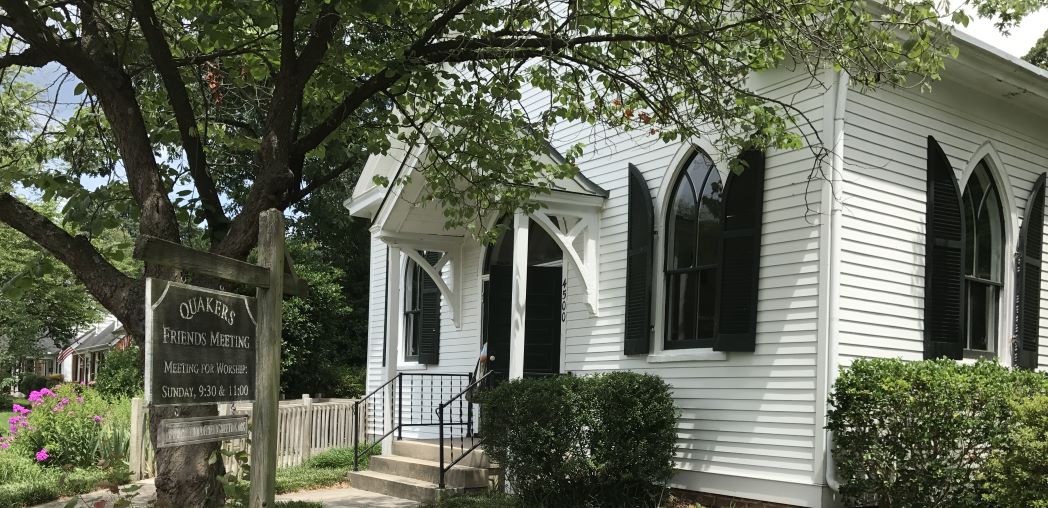
- RFM purchased the 4500 Kensington Avenue property in 1957. (The Colonial Place Christian Church, an affiliate of the Disciples of Christ, built the original building in 1913. The educational annex was added in 1931.) The cost of the 4500 Kensington Avenue property in 1957 was approximately $17,500.
- RFM has provided office and meeting space to hundreds of community groups. Religious groups that have used the 4500 Kensington Avenue property for their programs include the Congregation Or Ami, the Metropolitan Christian Church, an unaffiliated Roman Catholic group and Muslims.
- In the 1960s, RFM provided office and meeting space to the Richmond Area Association for Retarded Children. In 1967, RFM provided office space and volunteer support to the statewide antiwar Vietnam Summer Project. In 1971, RFM provided office space to the statewide Virginia Council for Human Relations until the Richmond Zoning Board opposition and a neighborhood petition of 1,200 signatures forced the interracial organization to relocate.
- Since 1957, RFM has provided financial assistance and social support to Russian, Vietnamese, Cambodian and Central American refugees, who have relocated to the Richmond area.
- The 4500 Kensington Avenue property has been the site of countless weddings and memorial ceremonies, not only of Friends but also from the community at large.
- In 1986, RFM, overflowing with new attenders, established new worship groups in Ashland and Midlothian. Midlothian has since become a full-fledged meeting.
See below for a slide show of History of Quakers in Central Virginia
by WebPost | Dec 18, 2008 | History - Quaker, Peace and Social Concerns, Testimonies, Writings - RFM
Friends affirm a Biblical basis for the peace testimony. A Prince of Peace was prophesied who would bring in a Peaceable Kingdom. “Thou shalt not kill” is one of the Ten Commandments. Jesus taught and lived peacemaking and love of enemy. George Fox similarly counseled his followers “to live in the life and power which does away with the occasion for war.”
The material below was prepared earlier by Mary Fran Hughes-McIntyre and is excerpted from her History of Richmond Friends Meeting, 1795-1962, available in the Meeting Library. (or here:THE HISTORY OF RICHMOND FRIENDS MEETING 1795-1962)
Living Out the Peace Testimony
Friends affirm a Biblical basis for the peace testimony. A Prince of Peace was prophesied who would bring in a Peaceable Kingdom. “Thou shalt not kill” is one of the Ten Commandments. Jesus taught and lived peacemaking and love of enemy. George Fox similarly counseled his followers “to live in the life and power which does away with the occasion for war.”
Early Richmond Friends were firm pacifists, disowning from membership those who bore arms. Doubtless knowing Friends from Cedar Creek Meeting who had firmly refused to fight during the Revolutionary War, Friends in Richmond affirmed a pacifist stand in the War of 1812. Friends suffered payment of muster fines rather than fight. As part of Virginia Yearly Meeting, they concurred with the following statement:
While we view with sorrow the awful progress of war spreading desolation and Misery in the human family, let us endeavor to guard our Minds from mixing in the politics of the times, which will insensibly leven into the spirit, and will lead if not to the practice at least to the promotion of that destructive evil.
During the War between the States, some Richmond Friends chose to fight, and some were conscientious objectors. Cedar Creek Monthly Meeting (of which Richmond Friends became a part in 1841) accepted the resignation of three persons who chose to fight, but “earnestly hopes that the day is not distant when those with many others aroused by the awful juncture of war now presented to our view may be enabled to renounce principles which lead to such results and enlist under the banner of the Prince of Peace.”
In the period from 1914-1920 the Peace Committee of Richmond Friends meeting was particularly active workingfor peace and reconciliation in the period of the Great War. Peace literature was distributed in the schools, and prizes were offered in 1916 for the best essays on “Why We Do Not Need a Large Increase in our Army and Navy”: $15 first prize to a boys’ school, $10 first prize to a girls’ school. (Editor: Friends have not been free from societal sexism and racism.) Money was donated for Belgian relief in 1914, for English and Armenian relief in 1916, for French orphans in 1917, and for feeding the German children in 1920. Letters were sent to Senators and Representatives in 1916 urging opposition to the so-called “preparedness” for war. The Friends Peace Committee ran two advertisements in the newspapers, including the following:
PEACE OR WAR?
To our fellow-citizens:
In this time of crisis when our country’s highest good is the common aim of all, we voice this deep conviction of patriotic duty.
The causes for which men fight—liberty, justice, and peace—are noble and Christian causes. But war itself violates law, justice, liberty and peace, the very ends for which alone its tragic costs might be justified…
In World War II, Friends were again active in peace-making. Member Hoge Ricks met at homes in 1940 with young Friends to think through their stands on the peace testimony in anticipation of their being faced with conscription. After the war opposition to conscription continued, with visits to Congressional Representative, and a firm stand against the Selective Service Act of 1948.
A change in Friends’ custom of disowning those who bear arms in evident in 1943. A member wrote saying that he had joined the Armed Forces as a result of personal conviction, and that he doubted the Meeting wanted his membership. The Meeting decided to stay in touch with him, since “to encourage him would do more that to ostracize him.”
(Richmond) Friends were proud of having several members, who were conscientious objectors, serving in Civilian Public Service Camps. Their peace testimony was affirmed.
Thus, Richmond Friends stood consistently against war, and dealt in increasingly lenient ways with Friends who chose to fight.
* * * *
(Editor: During World War II, some 12,000 men who were conscientious objectors to war, served in non-military occupations across the U.S. Under the leadership of Mennonite, Quaker and Church of the Brethren agencies, they were engaged in mental health care and medical experiments, in forestry and diary farming, and in other important civic projects.)
by WebPost | Dec 20, 2007 | Writings - Quaker Bibliography
Friends for 350 Years
BY HOWARD BRINTON, WITH AN HISTORICAL UPDATE BY MARGARET HOPE BACON
Overview of basic Quaker understandings and practices. Topics covered include the light within, meeting for worship, vocal ministry, reaching decisions, the meeting community, the meeting and the world, the four periods of Quaker history, and Quaker thought. Pendle Hill 2002 348 PP. Paper $16.00
Quaker Spirituality: Selected Writings
EDITED BY DOUGLAS STEERE A comprehensive collection of Quaker writings including George Fox, Isaac Penington, John Woolman, Caroline Stephen, Rufus Jones and Thomas Kelly. The introduction is a thoughtful brief history of Friends. Paulist Press 1984 334 PP. Paper $24.95
There is also an abridged edition. HarperSanFrancisco 2005 128 PP. Paper $11.95
The introduction can be purchased separately. Philadelphia Yearly Meeting 1988 56 PP. Paper $3.95
Encounter with Silence: Reflections from the Quaker Tradition
BY JOHN PUNSHON ”He presents the uniqueness of Quaker faith and practice while also relating it to the tradition of Christian spirituality.” -Parker J. Palmer
Friends United Press/Britain Yearly Meeting 1987 131 PP. Paper $12.00
Quaker Reader
EDITED BY JESSAMYN WEST Popular anthology of Quaker writings (1650-1960). Writings represent a wide range of perspectives; includes fine biographical notes at the beginning of each passage. An excellent and deep survey of Friends’ thought. Pendle Hill 1990 540 PP. Paper $17.50
Beyond Consensus: Salvaging Sense of The Meeting
BY BARRY MORLEY “In seeking the sense of the meeting we open ourselves to being guided to perfect resolution in the Light, to a place where we sit in unity in the collective inward Presence. Through consensus we decide it; through sense of the meeting we turn it over, allowing it to be decided.”
Pendle Hill 1996 32 PP. Paper $4.00
Beyond Majority Rule: Voteless Decision Making in The Religious Society Of Friends
BY MICHAEL J. SHEERAN
Michael Sheeran, a Jesuit scholar, studied the actual decision making process used among Friends. This book is the result of his study and he includes detailed descriptions of the process at work and draws conclusions about what works well and what does not. Philadelphia Yearly Meeting 1983 153 PP. Paper $12.00
Portrait in Grey: A Short History
BY JOHN PUNSHON
Traces the beginnings of the Religious Society of Friends, its distinctive way of life, and its explosive expansion in England and elsewhere. Britain Yearly Meeting 1984 293 PP. Paper $16.50
Silence And Witness: The Quaker Tradition
BY MICHAEL L. BIRKEL This is a new, meaty and inviting introduction to Quaker thought and spiritual life. The chapter entitled ‘The Facing Bench’ lifts up well selected quotations of prominent Friends on topics such as ‘The Immediate Presence of God,’ ‘The Universal Light of Christ,’ and ‘The Spiritual Basis of Peace.’ His chapter on the inward experience of worship is both an excellent introduction and a seasoned examination of centering techniques. Orbis 2004 144 PP. Paper $16.00
Essays On The Quaker Vision Of Gospel Order
BY LLOYD LEE WILSON Essays address facets of Quaker faith and practice, articulating the ways in which Gospel order has shaped lives and beliefs of Friends. Wilson gives the reader both a historical perspective and a contemporary understanding of basics like meeting for worship and for business, spiritual gifts, leadings and ministry. Seasoned Friends and those new to Quakerism will find much to ponder. Quaker Press of FGC 2002 200 PP. Paper $17.00
The Testimony Of Integrity
BY WILMER COOPER The call for integrity in daily life lies at the heart of Quakerism. It reflects Friends devotion to truth, honesty, authenticity, and wholeness. This pamphlet claims that the Testimony of Integrity should undergird all the Quaker testimonies and should become the guiding principle for daily living. Pendle Hill 1991 32 PP. Paper $4.00
Listening To The Light: How To Bring Quaker Simplicity And Integrity Into Our Lives
BY JIM PYM This book is an essential contemporary introduction to Quakerism written by a noted British Friend. Using many quotations from Britain Yearly Meeting’s Faith and Practice and other prominent sources, Pym summarizes Quaker thought and spiritual practice without over-simplifying it. Rider Books 1999 192 PP. Paper $16.95
Faith In Action: Quaker Social Testimony
ESSAYS BY JONATHAN DALE AND OTHERS.
Where do we stand on lived witness, on social testimony? Both in the essay by Jonathan Dale and the short contributions from many Friends, we get a glimpse at other people’s experience of the living truth. As Jonathan Dale says, “The more the Light is followed, the deeper the joy and the readier we may be for the next step.” This book will inspire readers to think about how we live out our testimonies in our lives, develop a culture of mutual accountability, and share the lessons from our journeys. When we say God is love, the integrity of our claim is known by the degree to which it is lived out in our lives. Britain Yearly Meeting 2000 292 PP. Paper $20.00
Faith and Practice of Baltimore Yearly Meeting
Baltimore Yearly Meeting’s book of discipline. Baltimore Yearly Meeting 1988 Paper $13.50
Pricing listed may not be current.
The above may be purchased at:
Friends Book Store
Pendle Hill Books
Baltimore Yearly Meeting Publications
Philadelphia Yearly Meeting Publications

by WebPost | Dec 18, 1962 | History - RFM, Writings - RFM
THE HISTORY OF RICHMOND FRIENDS MEETING
1795–1962
by
Mary Fran Hughes
Richmond, Virginia
1979
Since joining Richmond Friends Meeting in 1976, I have wondered about the history of my new spiritual family. A sense of our history might give us an appreciation for who we are and can become. Realizing that hardly any of the present active members had been in the Meeting prior to 1960 left me wondering about the danger of our being cut off from our heritage — no one even seemed to know how long it stretched back. (Photo 2003)
My interest was encouraged by Jay Worrall, official historian for Virginia Friends, who generously opened his card files on Virginia Friends’, history. Patricia Hickin, a historian who has worked with the Virginia State Library, likewise shared her historical resources and her enthusiasm for the project. Eda Martin whose interest in family history led to study of Quaker ancestors in Richmond Friends Meeting brought forth notes, books, watercolor portraits, a pilgrimage to Friends’ graves in Hollywood Cemetery, and a deep concern for historical accuracy. The occasion for the history-writing was James Smylie’s American Religious History course at Union Theological Seminary. His insistence that I learn about the broader contexts of Virginia, Richmond, national, and American religious history added depth and occasional discoveries about the topic itself. These persons and William McIntyre read the following history and offered editorial suggestions.
Discovering a history which went hack all the way to 1795 and which was passed down through a single family for about 150 years was breath-taking. With the Meeting’s current Friends General Conference (more Hicksite) orientation, we have a long heritage of Orthodoxy through the lifetime of the Crenshaw family in the Meeting. Our testimonies on peace and reform of the social order have been faithfully lived out as Friends have met silently to wait upon the Lord. From worship came fresh strength and perspective.
Since no systematic history of Richmond Friends Meeting has been previously written, I feel a responsibility to choose themes and to organize them in a way which grows out of the history itself. The hope is that contemporary and future Richmond Friends may gain insight through what has been lived out before. Yet, the focus is on issues alive today. With the current efforts to revive the draft, I have focused on our pacifist history which responded to each war or rumor of war with a peace-making stand. The Meeting’s recent sponsorship of eleven Cambodian refugees is in harmony with Friends testimony on race relations and the abolition of slavery. As we wrestle with our ministry in the prisons and in opposition to capital punishment, we look to our predecessors who did likewise.
May our history move us to “walk cheerfully over the world, looking for that of God in every person.”
Read full paper (PDF)…. THE HISTORY OF RICHMOND FRIENDS MEETING 1795-1962
![The Winston House]()
by WebPost | Dec 19, 1800 | History - Quaker, History - RFM
George and Judith Winston were birthright Quakers who were active with Richmond area Quakers in the late 18th and early 19th centuries. George was a maker of bricks and a builder so he built the first Meetinghouse at 20th and Cary Street in 1797. This building no longer exists but a needlework sampler sewed by his daughter Mary in 1806 shows us the front and the back of the brick Meeting House. Records also show that the Meeting did not finish payment to George Winston for the 30 by 40-foot square building until 1816.

The house in the photograph was built by George Winston in Church Hill, built about 1810 and was probably used for his business.It was located between 25th and 26th and Broad and Grace Streets in the area we know today as Church Hill. At that time the area was known as Shed Town, perhaps because there were so many sheds in the backyards. Winston used the backyard for his brickyard. The Winstons became strong opponents of slavery and as a result, George did not hire slaves to work in his construction business. Instead he trained free black apprentices for the work. George and Judith may have lived here from 1810-1816 when they moved their residence to 2604 East Franklin Street.
George and Judith were originally members of and were married under the care of the White Oak Swamp Meeting about 15 miles out of Richmond in Henrico county. We believe that once they lived in Richmond and the Richmond Meeting was organized that they probably became active in the Richmond Meeting since it was more convenient. They were the parents of 14 children. Interestingly Judith though in 1810 was placed under the care of the White Oak Swamp Meeting for not attending meetings. She confessed that it was true and accepted the rebuke. However, she did not resume her attendance at meetings and she was condemned for having encouraged her daughter in going to plays and dances. She was dismissed from the Society on July 6, 1811. Judith may well have become disenchanted with her restricted life of constant pregnancy and felt that she wanted more for her daughters. She may have simply been too tired to continue to make the effort to attend meetings.
Henrico County court records show that George took seriously that he should not hold slaves and instead should prepare free black apprentices with job skills. Repeatedly in the records are agreements to teach an apprentice a trade. In June 1804, George Winston had placed with him, Daniel, a free, black, orphan boy to learn the trade and mystery of a house joiner. “Apprentice is to serve from the date thereof for a period of nine years, nine months and seven days or until Daniel arrives at the age of twenty-one.” The 1820 census listed twenty-one male free blacks ranging in age from 14-25 living and working with Winston. George was also a trustee of the Gravely Hill School, a Quaker institution for the education of blacks.
Business was good. George had begun to build houses and stores at a time when Richmond was growing rapidly. He built the block of stores at 14th and Main along with many other buildings. It is said that he also provided bricks and lime for the building of the state penitentiary and for the new Capitol. In 1817, he built the Jacob House, now located at Pine and Cary. This may be his last standing building.
The photograph is provided us courtesy of the Library of Virginia
Our thanks to Charles Pool, Virginia Davis, Gregg Kimball and the Library of Virginia for the above information and for the photograph.