by WebPost | Dec 18, 2008 | History - RFM
- Richmond Friends Meeting (RFM) organized in 1795, and soon built its first Meeting House at 19th and Cary Street in Church Hill. This was the second oldest “church” in Richmond. We have a long history of religious observance and social justice within the Richmond community. In 1995, we celebrated our 200th birthday.
- Richmond area Quakers established the Virginia Abolition Society in 1790. With the Civil War, RFM established the Friends Asylum for Colored Orphans, now called the Friends Association for Children. After slave emancipation, RFM member Sarah Smiley and other Quaker women helped start a school for over 1,000 free black adults and children in Richmond.
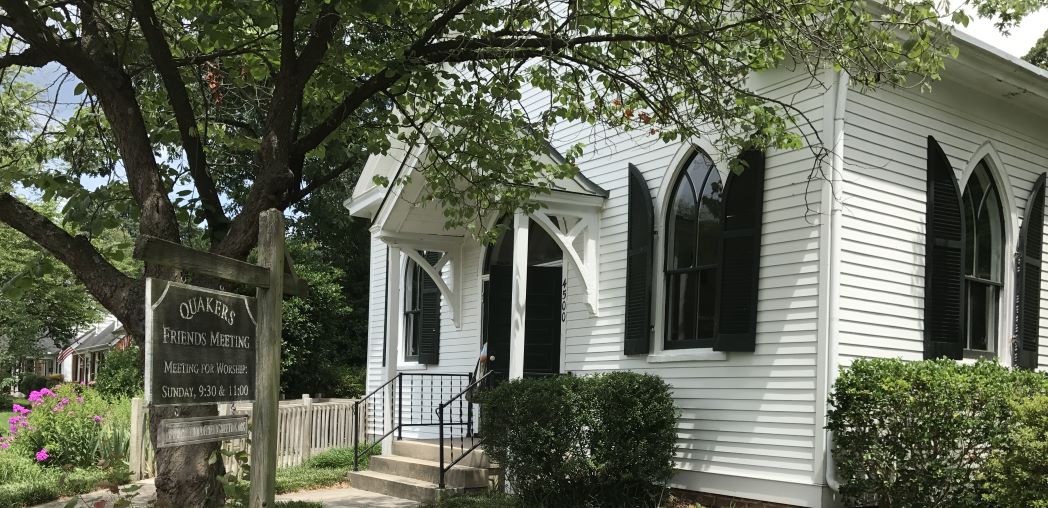
- RFM purchased the 4500 Kensington Avenue property in 1957. (The Colonial Place Christian Church, an affiliate of the Disciples of Christ, built the original building in 1913. The educational annex was added in 1931.) The cost of the 4500 Kensington Avenue property in 1957 was approximately $17,500.
- RFM has provided office and meeting space to hundreds of community groups. Religious groups that have used the 4500 Kensington Avenue property for their programs include the Congregation Or Ami, the Metropolitan Christian Church, an unaffiliated Roman Catholic group and Muslims.
- In the 1960s, RFM provided office and meeting space to the Richmond Area Association for Retarded Children. In 1967, RFM provided office space and volunteer support to the statewide antiwar Vietnam Summer Project. In 1971, RFM provided office space to the statewide Virginia Council for Human Relations until the Richmond Zoning Board opposition and a neighborhood petition of 1,200 signatures forced the interracial organization to relocate.
- Since 1957, RFM has provided financial assistance and social support to Russian, Vietnamese, Cambodian and Central American refugees, who have relocated to the Richmond area.
- The 4500 Kensington Avenue property has been the site of countless weddings and memorial ceremonies, not only of Friends but also from the community at large.
- In 1986, RFM, overflowing with new attenders, established new worship groups in Ashland and Midlothian. Midlothian has since become a full-fledged meeting.
See below for a slide show of History of Quakers in Central Virginia
by WebPost | Dec 18, 2008 | History - Quaker, Peace and Social Concerns, Testimonies, Writings - RFM
Friends affirm a Biblical basis for the peace testimony. A Prince of Peace was prophesied who would bring in a Peaceable Kingdom. “Thou shalt not kill” is one of the Ten Commandments. Jesus taught and lived peacemaking and love of enemy. George Fox similarly counseled his followers “to live in the life and power which does away with the occasion for war.”
The material below was prepared earlier by Mary Fran Hughes-McIntyre and is excerpted from her History of Richmond Friends Meeting, 1795-1962, available in the Meeting Library. (or here:THE HISTORY OF RICHMOND FRIENDS MEETING 1795-1962)
Living Out the Peace Testimony
Friends affirm a Biblical basis for the peace testimony. A Prince of Peace was prophesied who would bring in a Peaceable Kingdom. “Thou shalt not kill” is one of the Ten Commandments. Jesus taught and lived peacemaking and love of enemy. George Fox similarly counseled his followers “to live in the life and power which does away with the occasion for war.”
Early Richmond Friends were firm pacifists, disowning from membership those who bore arms. Doubtless knowing Friends from Cedar Creek Meeting who had firmly refused to fight during the Revolutionary War, Friends in Richmond affirmed a pacifist stand in the War of 1812. Friends suffered payment of muster fines rather than fight. As part of Virginia Yearly Meeting, they concurred with the following statement:
While we view with sorrow the awful progress of war spreading desolation and Misery in the human family, let us endeavor to guard our Minds from mixing in the politics of the times, which will insensibly leven into the spirit, and will lead if not to the practice at least to the promotion of that destructive evil.
During the War between the States, some Richmond Friends chose to fight, and some were conscientious objectors. Cedar Creek Monthly Meeting (of which Richmond Friends became a part in 1841) accepted the resignation of three persons who chose to fight, but “earnestly hopes that the day is not distant when those with many others aroused by the awful juncture of war now presented to our view may be enabled to renounce principles which lead to such results and enlist under the banner of the Prince of Peace.”
In the period from 1914-1920 the Peace Committee of Richmond Friends meeting was particularly active workingfor peace and reconciliation in the period of the Great War. Peace literature was distributed in the schools, and prizes were offered in 1916 for the best essays on “Why We Do Not Need a Large Increase in our Army and Navy”: $15 first prize to a boys’ school, $10 first prize to a girls’ school. (Editor: Friends have not been free from societal sexism and racism.) Money was donated for Belgian relief in 1914, for English and Armenian relief in 1916, for French orphans in 1917, and for feeding the German children in 1920. Letters were sent to Senators and Representatives in 1916 urging opposition to the so-called “preparedness” for war. The Friends Peace Committee ran two advertisements in the newspapers, including the following:
PEACE OR WAR?
To our fellow-citizens:
In this time of crisis when our country’s highest good is the common aim of all, we voice this deep conviction of patriotic duty.
The causes for which men fight—liberty, justice, and peace—are noble and Christian causes. But war itself violates law, justice, liberty and peace, the very ends for which alone its tragic costs might be justified…
In World War II, Friends were again active in peace-making. Member Hoge Ricks met at homes in 1940 with young Friends to think through their stands on the peace testimony in anticipation of their being faced with conscription. After the war opposition to conscription continued, with visits to Congressional Representative, and a firm stand against the Selective Service Act of 1948.
A change in Friends’ custom of disowning those who bear arms in evident in 1943. A member wrote saying that he had joined the Armed Forces as a result of personal conviction, and that he doubted the Meeting wanted his membership. The Meeting decided to stay in touch with him, since “to encourage him would do more that to ostracize him.”
(Richmond) Friends were proud of having several members, who were conscientious objectors, serving in Civilian Public Service Camps. Their peace testimony was affirmed.
Thus, Richmond Friends stood consistently against war, and dealt in increasingly lenient ways with Friends who chose to fight.
* * * *
(Editor: During World War II, some 12,000 men who were conscientious objectors to war, served in non-military occupations across the U.S. Under the leadership of Mennonite, Quaker and Church of the Brethren agencies, they were engaged in mental health care and medical experiments, in forestry and diary farming, and in other important civic projects.)
by WebPost | Dec 18, 2000 | History - Quaker, Peace and Social Concerns
[Below a transcription of the 1802 Quaker petition against slavery presented to the Virginia legislature. Among those signing this petition are Samuel Parsons (the father of Samuel Pleasants Parsons, whose house survives at 601 Spring Street in Oregon Hill) and James Ladd (the uncle of Elizabeth Ladd, who married Samuel Pleasants Parsons).]
(Source: Miscellaneous Petitions to the Virginia Legislature, December 17, 1802. Archives of the Virginia State Library.)
To the speaker and House of Representatives of Virginia.
The memorial and petition of the religious Society of Friends.
Respectfully shew:
That your memorialists, estimating the importance of those concerns, which must necessarily engage the Legislature – feel no disposition to intrude upon your valuable time, or request your attention to subjects of a trivial nature but where grievances affecting any class of the community, arise from a partial construction of the laws, or exist because the laws have provided no remedy, we conceive it to be a duty, congenial with the spirit of legislation, and due to the House, faithfully to represent the same – and solicit such redress, as justice and equity require. Impressed with these sentiments- and feeling moreover the impulse of Religious duty, on behalf of the helpless, and unprotected – your memorialist beg leave to represent, certain cases of suffering, for which (in the opinion of some of the Courts) the laws have provided no effectual relief.
* Such we apprehend is the case of minor slaves, left free by will, but committed during their minority to the care of legatees – such minors notwithstanding their undoubted rights – and a clear conviction in the Courts of their claim to freedom – merely for the want of a legal prohibition – and on a ground of a temporary claim to their service – have been carried out of the State, and beyond the reach of testimony establishing their title – with the evident risk of being forever deprived of their freedom.
II Your memorialist beg leave further to represent that the practice of steeling, and selling free people of Color, continues to be carried on in some parts of the State; encouraged, we believe, by the little danger of conviction the law appearing to require evidence that free persons were stolen, or sold with a Knowledge of their being such. The difficulty, or rather their impossibility of adducing such evidence, we trust, will be sufficiently apparent, as well as the necessity of effectually restraining a practice which operates directly against the dignity of the Government – and contrary to the interest and spirit of the law, violates the first principles of justice with impunity. Your memorialist represent these subjects – with a full confidence that the justice, humanity, and sound policy of the Legislature will meet them with approbation. It cannot be supposed that the Representatives of a free, and enlightened people, can fail to appreciate the value of liberty, to whatever description of persons it may legally belong, or that they will not extend the barriers of the law around this inestimable privilege.
Interested as men and Christians, in the sufferings of our injured fellow creatures, and on behalf of numbers, who stand exposed to the same dangers – and may be involved in the same calamity – we therefore respectfully petition – That the law providing for the emancipation of slaves by will, and the law, respecting the stealing and selling free persons may be revised and amended – or that the legislature may make such provision for these cases as in their wisdom shall seem just and expedient.
Signed by order, and on behalf of the Representatives of the aforesaid Society
by James Ladd
Micajah Crew
Samuel Parsons
Jesse Copeland
Benjamin Bates Jr.
* See proviso to the law allowing emancipation. Abridgm’t of the permanent public laws, page 281.
II “If any person shall hereafter be guilty of stealing or selling any free person for a slave, knowing the said person so sold to be free, and thereof shall be lawfully convicted , the person so convicted, shall suffer death without benefit of Clergy.” Abridgment of the laws, page 280.
Friends Memorial. Mem. of L. to Riddick, Dupree, Dulaney, Allen, Sheffey, Shackelford, Aylett, Dunton, Jennings, Gee, Sebull, Blow, Josiah Riddick
by WebPost | Dec 18, 1967 | History - RFM, Peace and Social Concerns, Testimonies
One of the most divisive events in 20th century U.S. history was the war in Vietnam. The antiwar movement gained national prominence in 1965, peaked in 1968, and remained powerful throughout the duration of the conflict. In June 1967, in keeping with our position against war, the Richmond Friends Meeting hosted in our Kensington Avenue building the office for the Vietnam Summer Project, a statewide program opposing U.S. involvement in Vietnam.
In June 1967, in keeping with our position against war, the Richmond Friends Meeting hosted in our Kensington Avenue building the office for the Vietnam Summer Project, a statewide program opposing U.S. involvement in Vietnam. Phyllis Conklin and Marii Hasegawa, representing the Women’s International League for Peace and Freedom, led the statewide Vietnam Summer Project. (The Richmond WILPF chapter, newly organized by Phyllis and Marie, had about ten active members.) Some Richmond Friends Meeting members were also active in the Vietnam Summer Project along with other community individuals, who opposed the war.
Ben Ragsdale, a young student, was hired to help coordinate the program, which had groups in Norfolk, Hampton, Northern Virginia, Charlottesville, Lexington, Roanoke and Farmville. Ben recalls doing a lot of moving around the state. He indicates that the college campuses were not as active as they were later because it was the summer and students were not in attendance. He also recalls receiving a small paycheck every two weeks.
The Vietnam Summer Project attempted to host a peaceful antiwar rally at the Richmond War Memorial but was denied a permit. The ACLU filed an injunction against the ruling, which found them before the newly installed Judge Mehrige in federal court. Judge Mehrige told them that it was a constitutional issue and refused an injunction until the case could be heard in federal court. When Phyllis and Marii protested that this was a one summer’s protest project and the convocation was to be the end of it, Judge Mehrige told them that he was certain there were enough concerned people to keep the group alive until the case could receive a proper hearing. Bob Conklin recalls that while the Judge was in favor of granting the permit, he delayed the opinion in part because of his newness on the bench and the public controversy over the war itself. The 1967 peace rally was held instead at Union Seminary. The court eventually ruled in favor of the Vietnam Summer Project and the peace rally at the War Memorial finally happened a year later with several hundred in attendance.
Minutes of the Richmond Friends Meeting show that the City of Richmond intervened in the Vietnam Summer Project by sending a letter to Meeting, arguing that we did not have a permit for allowing our building to be used for such a purpose. Since the Meeting had for years allowed numerous groups supporting a wide variety of social issues to use RFM for meetings and office space, we can conjecture that this time the city objected because the war was so divisive in the public mind. The Business Meeting though simply agreed to pay for the permit. Ben Ragsdale and Marii Hasegawa do not recall ever knowing about the permit issue so it may well be that the Meeting quietly went ahead and did their part to help the project without concerning others.
RFM member Peg Spangenthal recalls that her husband Art, who served in Italy in World War II, offered counseling to young men concerned about the draft. She remembers hosting groups at their home, where materials were distributed and young men role-played the offered advice. We believe that Jules Arginteanu from the Meeting also offered draft counseling.
Other project activists spoke to church and college groups and responded to media inquiries about why the war in Vietnam was wrong. Bob Conklin recalls attending a meeting at the Unitarian church, where right-wingers blocked the entrance and the hallways, pushing their cameras to within inches of antiwar activist faces before blinding them with flashes. The right-wingers were anxious to rough it up and antiwar activists expected worse. During the meeting, Bob recalls that the debate centered on who eventually should govern Vietnam. A woman, sensing that Phyllis Conklin would favor the Communists, asked, ” Who is there but the Communists to give it to?” Phyllis’s response was “Why, to the people, of course.” As a result, antiwar activists were not hassled on the way out.
Later the police planted an “informer” in the project. “Ed,” as he was known, was apparently a little too enthusiastic about his new mission. He was very anxious to help with mailings, because he wanted to obtain the WILPF mailing list. Organizers were able to put him off and give him inconsequential jobs. Later that year at a City Hall demonstration, members of the group recognized “Ed”—this time dressed in his police uniform. They had a good laugh as one after another they called out, “Hi, Ed!” Ben Ragsdale recalls another plainclothesman, who appeared at project events. His name was Ricky Duling and he eventually became “Sergeant Santa” at Christmas to area children.
This was also the beginning of the Friday peace vigils at the post office. For four years, Phyllis Conklin and other sturdy souls leafleted in opposition to the Vietnam War. In doing this, they were called many names. Phyllis loved to tell that hostility changed to curiosity and even some interest and support as the national challenges to the war increased. She told about a man who stopped her toward the end of the four years and said that he had been watching them all this time. In the beginning he thought they were crazy, but gradually over the years his attitude had changed and now he really admired their perseverance.
Marii Hasegawa recalls that Richmond Friends Meeting played an important role by providing office space and volunteer support. She also recalls that the key to the side door was often very hard to turn and hopes that we have repaired it.
Thanks to Marii Hasegawa, Bob Conklin, Wendy Northup, Ben Ragsdale, Peg Spangenthal, Ann Lane and others who offered information for the above story. Phyllis Conklin died in 1987. Marii Hasagawa, now age 84, resides in a retirement community in South Hadley, Massachusetts. She continues to be active in social justice issues and sends greetings to all her Richmond friends. Ben Ragsdale is presently the director of the Virginia Civil Rights Video Initiative. Betsy Brinson is responsible for the research and writing of this short article. Readers who have additional information to share about the Vietnam Summer Project are invited to contact her at brinson422@comcast.net

by WebPost | Dec 18, 1962 | History - RFM, Writings - RFM
THE HISTORY OF RICHMOND FRIENDS MEETING
1795–1962
by
Mary Fran Hughes
Richmond, Virginia
1979
Since joining Richmond Friends Meeting in 1976, I have wondered about the history of my new spiritual family. A sense of our history might give us an appreciation for who we are and can become. Realizing that hardly any of the present active members had been in the Meeting prior to 1960 left me wondering about the danger of our being cut off from our heritage — no one even seemed to know how long it stretched back. (Photo 2003)
My interest was encouraged by Jay Worrall, official historian for Virginia Friends, who generously opened his card files on Virginia Friends’, history. Patricia Hickin, a historian who has worked with the Virginia State Library, likewise shared her historical resources and her enthusiasm for the project. Eda Martin whose interest in family history led to study of Quaker ancestors in Richmond Friends Meeting brought forth notes, books, watercolor portraits, a pilgrimage to Friends’ graves in Hollywood Cemetery, and a deep concern for historical accuracy. The occasion for the history-writing was James Smylie’s American Religious History course at Union Theological Seminary. His insistence that I learn about the broader contexts of Virginia, Richmond, national, and American religious history added depth and occasional discoveries about the topic itself. These persons and William McIntyre read the following history and offered editorial suggestions.
Discovering a history which went hack all the way to 1795 and which was passed down through a single family for about 150 years was breath-taking. With the Meeting’s current Friends General Conference (more Hicksite) orientation, we have a long heritage of Orthodoxy through the lifetime of the Crenshaw family in the Meeting. Our testimonies on peace and reform of the social order have been faithfully lived out as Friends have met silently to wait upon the Lord. From worship came fresh strength and perspective.
Since no systematic history of Richmond Friends Meeting has been previously written, I feel a responsibility to choose themes and to organize them in a way which grows out of the history itself. The hope is that contemporary and future Richmond Friends may gain insight through what has been lived out before. Yet, the focus is on issues alive today. With the current efforts to revive the draft, I have focused on our pacifist history which responded to each war or rumor of war with a peace-making stand. The Meeting’s recent sponsorship of eleven Cambodian refugees is in harmony with Friends testimony on race relations and the abolition of slavery. As we wrestle with our ministry in the prisons and in opposition to capital punishment, we look to our predecessors who did likewise.
May our history move us to “walk cheerfully over the world, looking for that of God in every person.”
Read full paper (PDF)…. THE HISTORY OF RICHMOND FRIENDS MEETING 1795-1962